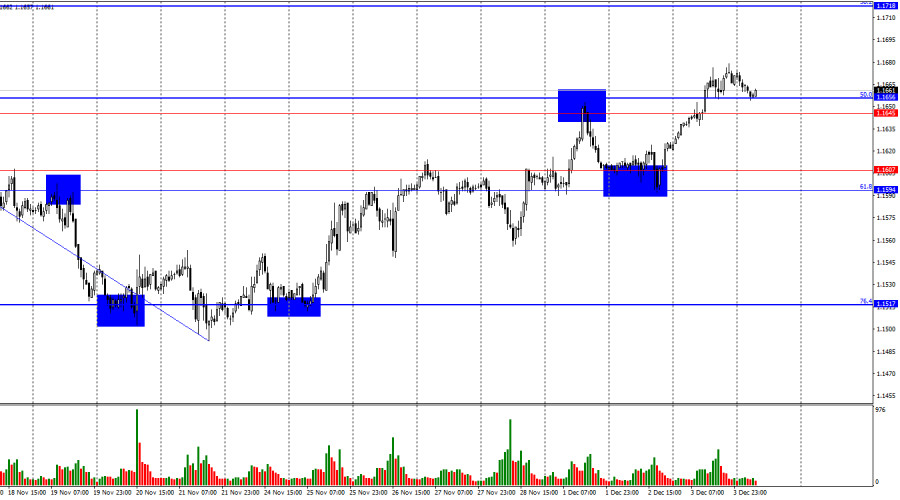
On Wednesday, the EUR/USD pair continued its upward movement after rebounding from the support level of 1.1594–1.1607 and by the end of the day closed above the 1.1645–1.1656 level. Thus, the upward movement may continue toward the next 38.2% retracement level at 1.1718. A consolidation of the pair below the 1.1645–1.1656 level will work in favor of the U.S. dollar and a return of the quotes to the 1.1594–1.1607 level.
The wave structure on the hourly chart remains simple and clear. The last completed downward wave did not break the previous low, while the most recent upward wave broke the previous peak. Therefore, the trend has now officially changed to "bullish." One can hardly call it a strong trend, but in recent months the bulls have shown only one thing—their weakness. Fed monetary easing should give them additional strength, as the ECB does not intend to cut interest rates anytime soon.
On Wednesday, the bears' hope rested on just one report—ADP. This report is not the most accurate or comprehensive indicator of the U.S. labor market, but there were no others available at the time. Apart from the ADP report, the ISM services PMI and industrial production were also released, but traders were waiting specifically for ADP, as the FOMC will make its monetary policy decision next week based on this data. There were faint hopes that the labor market would show at least slight improvement. Traders expected job growth of at least 10–15 thousand. However, reality shattered all hopes and expectations. The labor market lost another 32,000 jobs, and the revision of last month's figure to +47,000 played no role. The Fed now has no choice but another 0.25% rate cut. Previously, traders doubted this decision (given the complete lack of necessary data), but now they are 100% certain.

On the 4-hour chart, the pair returned to the resistance level of 1.1649–1.1680. A rebound from this level will again work in favor of the U.S. dollar and lead to a decline toward the 38.2% Fibonacci level at 1.1538. Consolidation above the 1.1649–1.1680 resistance level will increase the likelihood of continued growth toward the next 0.0% retracement level at 1.1829. No emerging divergences are observed in any indicator today. The bullish trend has every chance to recover.
Commitments of Traders (COT) Report:

During the most recent reporting week, professional traders closed 12,897 long positions and 2,857 short positions. COT reports have resumed after the shutdown, but the data currently being released is outdated—October figures. The sentiment of the "Non-commercial" group remains bullish thanks to Donald Trump and continues to strengthen. The total number of long positions held by speculators now stands at 243,000, with 135,000 short positions.
For thirty-three consecutive weeks, major players have been reducing short positions and increasing long positions. Donald Trump's policies remain the most significant factor for traders, as they may cause many long-term structural problems for the U.S. Despite several important trade agreements being signed, many key economic indicators continue to decline, and the dollar is losing its status as the "world's reserve currency."
News Calendar for the U.S. and the Eurozone:
On December 4, the economic calendar includes two entries, neither of which can be considered important. The influence of the informational background on market sentiment on Thursday will be weak.
EUR/USD Forecast and Trader Recommendations:
Short positions today are possible if the pair closes below the 1,1645–1,1656 level on the hourly chart, targeting 1.1594–1.1607. Long positions could be opened upon a rebound from the 1.1594–1.1607 level with a target of 1.1645–1.1656. This target has been reached. Today, long positions may be kept open with a target of 1.1718.
The Fibonacci grids are built from 1.1392–1.1919 on the hourly chart and from 1.1066–1.1829 on the 4-hour chart.
RYCHLÉ ODKAZY




















 Kontaktujte nás