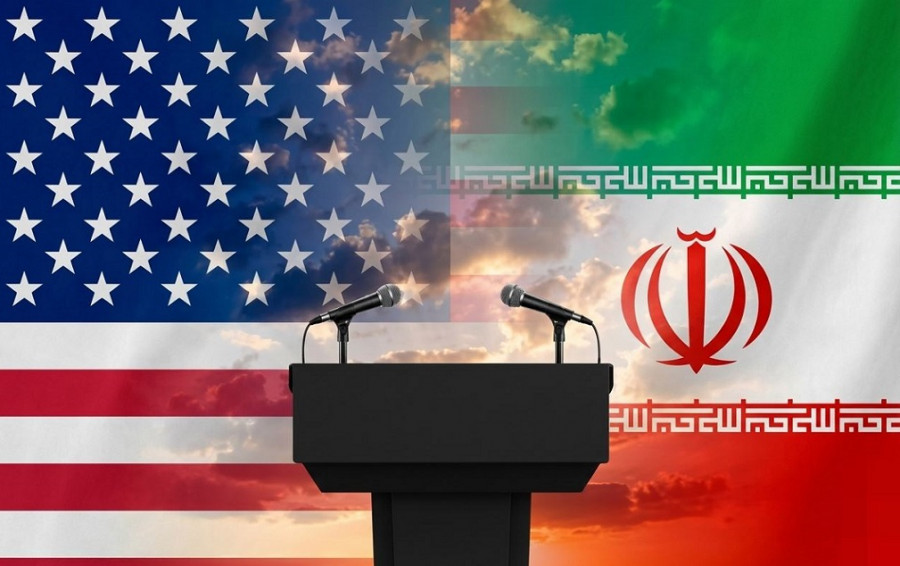
The EUR/USD pair continues to trade within a narrow price range amid a sparse economic calendar and ongoing uncertainty surrounding U.S.-Iran negotiations. The amplitude of price fluctuations has narrowed to 20–40 pips, indicating indecision among traders, both buyers and sellers of the pair. The surge of optimism regarding a "quick deal" has gradually faded, yet market participants still anticipate reaching an agreement in the near future. Based on the signals received, these expectations appear quite justified.
The "indicator of optimism" here is more likely the oil market rather than the currency market. The price of Brent crude oil for July delivery has decreased by more than 3% to $96.38 per barrel. The price of WTI (for delivery in the same month) has dropped nearly four percent (3.9%) to $90.25. Oil traders continue to bet on the imminent reopening of the Strait of Hormuz, especially since the first vessels have already passed through this transportation artery. According to Bloomberg, at least two large oil tankers (not Iranian) left the Persian Gulf in the past 24 hours.
Nevertheless, EUR/USD traders are not in a hurry to open large positions in favor of the euro, as the situation remains in a precarious state. The parties are refraining from official comments, so traders can only rely on insider information from global media, which amounts to little more than rumors.
To summarize all the incoming information, we get the following picture: the United States and Iran have been discussing a draft preliminary agreement through intermediaries over the past few days, which includes a transitional 60-day period. The draft deal encompasses mutual concessions. Tehran, for example, must fully open the Strait of Hormuz, carry out mine clearance of the maritime area, and refrain from imposing any tariffs on commercial vessels. In turn, the U.S. must lift the naval blockade of Iranian ports and allow Iran to resume oil exports. Additionally, Tehran demands the immediate unfreezing of half of its blocked assets upon signing the deal, with the remaining portion to be unfrozen within 60 days (as other conditions of the agreement are met).
However, it is important to clarify that this information portrays a compilation of insights from Western media (in particular, Axios and The Guardian), while Iranian sources publish somewhat different information. Specifically, according to the Iranian channel Press TV, Tehran has prepared its own draft memorandum of understanding with the U.S., which includes the withdrawal of American troops from all bases near Iran and the immediate lifting of the naval blockade of Iranian ports. Only after fulfilling these conditions will Tehran commit to restoring navigation through the Strait of Hormuz to pre-war levels within a month. Even then, Iran intends to maintain a role in the management of the strait—albeit jointly with Oman, rather than unilaterally.
Whether this information is accurate or part of the informational standoff within diplomatic negotiations is unknown. However, if Tehran genuinely insists on such conditions, the negotiation process may again stall and possibly reach a deadlock, as these demands are clearly unacceptable to Trump and, consequently, to the United States.
In other words, the intrigue remains, and the balance can tilt either towards escalation or de-escalation.
Under such uncertainty, the heightened caution of EUR/USD traders is quite justified. After all, the future dynamics of geopolitical tension are at stake, which will influence the balance of demand for risk assets and the safe dollar, ultimately determining the direction of the pair's movement.
All other fundamental factors are not even secondary but rather tertiary, especially since the economic calendar for this week is not rich in significant events for EUR/USD. More or less meaningful releases are simply ignored by traders.
For instance, on Tuesday, the Conference Board's consumer confidence index was released in the U.S. and was in the "green zone." Instead of the expected decline to 91.9, the figure stood at 93.1. De facto, the index showed a downward trend, falling by 0.7 points compared to the revised improvement in the April result (93.8). The assessment of current conditions significantly weakened due to cooling in the labor market, while the short-term expectations index symbolically rose on hopes for peaceful negotiations.
Despite the "green color" of the release, traders effectively overlooked it, focusing solely on the geopolitical agenda.
This once again indicates that until the resolution of the Middle Eastern narrative, the EUR/USD pair will likely oscillate within the range of 1.1620–1.1660 (the lower boundary of the Kumo cloud—the upper line of the Bollinger Bands indicator on the H4 timeframe), trading the boundaries of this price range.
RYCHLÉ ODKAZY



















 Kontaktujte nás