Trade Review and Trading Recommendations for the Japanese Yen
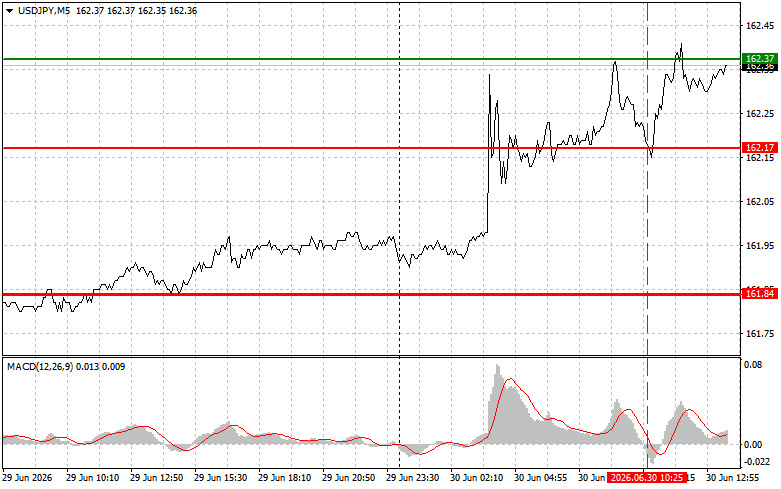
The test of the 162.17 level occurred when the MACD indicator had just started moving below the zero line, confirming a valid entry point for selling the U.S. dollar. However, the trade resulted in a loss, as the pair failed to move lower.
The market's focus now shifts to the release of key U.S. economic data. In particular, the U.S. Consumer Confidence Index is expected to provide insight into the sentiment of American households and their willingness to spend. Data from the U.S. Bureau of Labor Statistics on job openings and labor turnover will also be closely watched. Ahead of Friday's closely followed employment report, this release will be particularly important. These indicators serve as key gauges of labor market conditions and could significantly influence expectations regarding the Federal Reserve's next monetary policy decisions.
In addition, market participants will closely monitor the Housing Price Index, which reflects trends in one of the economy's key sectors. Together, these macroeconomic releases will play an important role in determining the near-term direction of the U.S. dollar against the Japanese yen. Any deviation from forecasts, whether positive or negative, could trigger significant volatility in the foreign exchange market.
As for my intraday trading strategy, I will primarily rely on the implementation of Scenario No. 1 and Scenario No. 2.
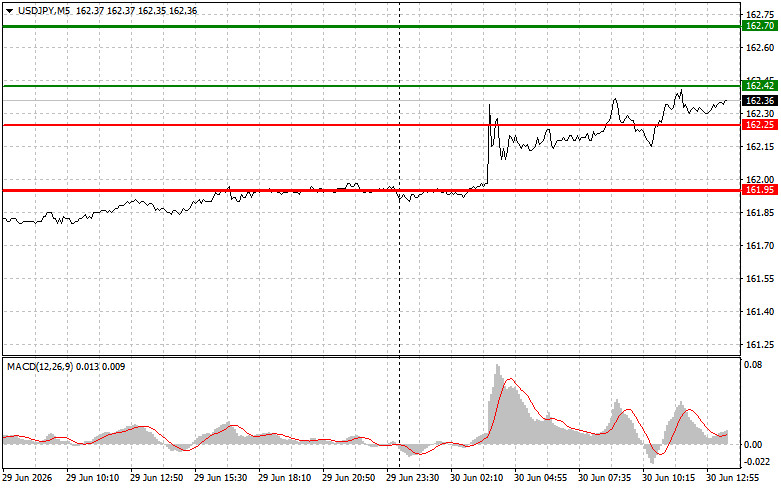
Scenario No. 1: I plan to buy USD/JPY if the price reaches the entry level around 162.42 (the green line on the chart), targeting a rise to 162.70 (the thicker green line on the chart). Around 162.70, I plan to close long positions and open short positions, targeting a 30–35 point move in the opposite direction. Any upside in the pair today is expected to be relatively limited.
Important: Before buying, make sure the MACD indicator is above the zero line and has just started moving higher.
Scenario No. 2: I also plan to buy USD/JPY if the price tests 162.25 twice consecutively while the MACD indicator is in oversold territory. This would limit the pair's downward potential and could trigger a bullish reversal. In this case, a rise toward 162.42 and 162.70 can be expected.
Scenario No. 1: I plan to sell USD/JPY after the price breaks below 162.25 (the red line on the chart), which could trigger a rapid decline in the pair. The key downward target for sellers is 161.95, where I plan to close short positions and immediately consider opening long positions, targeting a 20–25 point rebound. Selling pressure on the pair is likely to return today if the central bank intervenes.
Important: Before selling, make sure the MACD indicator is below the zero line and has just started moving lower.
Scenario No. 2: I also plan to sell USD/JPY if the price tests 162.42 twice consecutively while the MACD indicator is in overbought territory. This would limit the pair's upward potential and could trigger a bearish reversal. In this case, a decline toward 162.25 and 161.95 can be expected.
Important: Beginner Forex traders should exercise extreme caution when entering the market. It is generally advisable to stay out of the market before the release of major fundamental reports to avoid sharp price fluctuations. If you decide to trade during news releases, always use stop-loss orders to minimize potential losses. Trading without stop-loss orders can quickly result in losing your entire deposit, especially if you trade large position sizes without applying proper money management.
Finally, remember that successful trading requires a clear trading plan, such as the one outlined above. Making spontaneous trading decisions based solely on current market conditions is generally a losing strategy for intraday traders.

QUICK LINKS



















 Contact Us