Bank of England ponechala ve čtvrtek úrokové sazby na úrovni 4,25 %, jak se očekávalo, ale naznačila možnost dalšího uvolnění měnové politiky kvůli oslabujícímu trhu práce a rostoucím cenám energií. Měnový výbor hlasoval poměrem 6:3 pro ponechání sazeb, přičemž tři členové – včetně guvernéra Davea Ramsdena – byli pro snížení o čtvrt procentního bodu. Guvernér Andrew Bailey uvedl, že sazby zůstávají na sestupné trajektorii, ale nejsou na žádné předem stanovené cestě.
Bailey upozornil, že světová situace je velmi nestabilní a že v Británii už dochází k viditelnému oslabování trhu práce, které se může promítnout do spotřebitelské inflace. Banka zároveň poznamenala, že eskalace konfliktu na Blízkém východě zatím nehrála roli při červnovém rozhodování, ale bude pečlivě sledována kvůli dopadům na ceny energií a celkovou ekonomickou stabilitu.
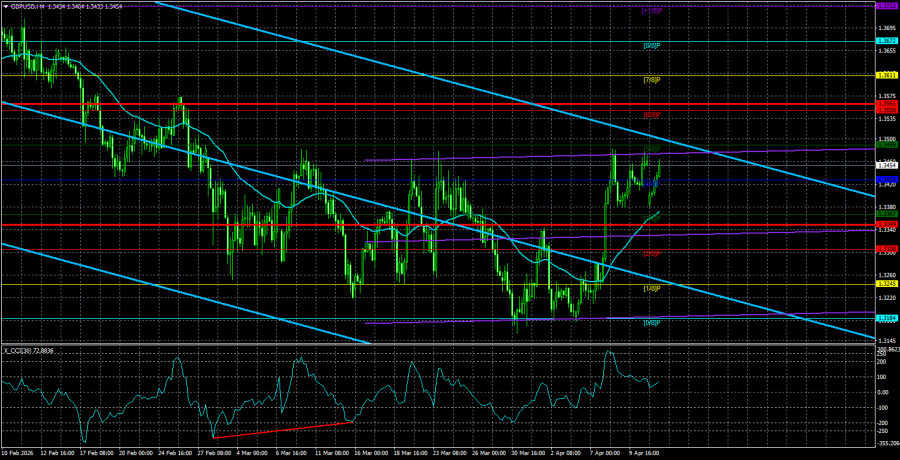
The GBP/USD currency pair traded in a downward trend on Monday, which was completely predictable. Some experts likely expected that by noon, the dollar would rise by 200 pips, but why rush for the market? It has been ignoring all non-geopolitical factors, and there is plenty of time to buy the US currency. Therefore, we believe the dollar will begin a systematic rise amid new escalations in the Middle East.
What does this new escalation entail? It involves Trump's threats to block the Strait of Hormuz. Many traders may ask: why block a strait that is already blocked? Trump wants to block it for Iranian tankers and ships. Simply put, Iran has blocked the Strait to prevent oil from hostile countries in the region from entering global markets. In essence, this is blackmail against the whole world, because aggression against Iran has been displayed by the US, and high prices for fuel, oil, and gas have affected everyone. Now, the American president wants to make Iran suffer by using the same method—simply cutting off oil supplies from Iran to China and other countries in the Far East.
How feasible is this? Frankly, Trump's threats seem unrealistic. Trump has already promised to "destroy the Iranian nation," to seize Kharg Island, and much more. However, almost any military expert will tell you that an operation of this magnitude would result in huge losses for the American military and enormous financial outlays. And their positive outcome is by no means guaranteed. Essentially, such an operation is an adventure, and the leader of the White House understands this very well.
However, Trump has little leverage left. He no longer has anything to pressure Iran into signing a peace agreement on Washington's terms. Iran has shown its readiness to defend its political regime, the direction of its international and domestic policies, and its independence and sovereignty for as long as necessary. Trump's plans do not include bombing Iran for the next few years, especially since Iran actively retaliates against those countries within range of its missiles and drones.
Meanwhile, oil prices are rising, and Iran threatens that, in the event of a US blockade of the Strait of Hormuz, it will also block the Bab-al-Mandab Strait, which would certainly push oil prices to $150-$200 per barrel. Who would be blamed in this case? The same person as now—Donald Trump. Who will vote for the Republican Party in November 2026 if oil prices rise by another $50-$100 per barrel? No one. Therefore, Trump is desperately trying to find a way out of a situation he himself created. Currently, we see little chance of the conflict ending on American terms. Instead of a cheap dollar, Trump may now revel in a rising dollar and face tightening rather than easing from the Federal Reserve, as inflation jumped by 0.9% year-on-year in March.
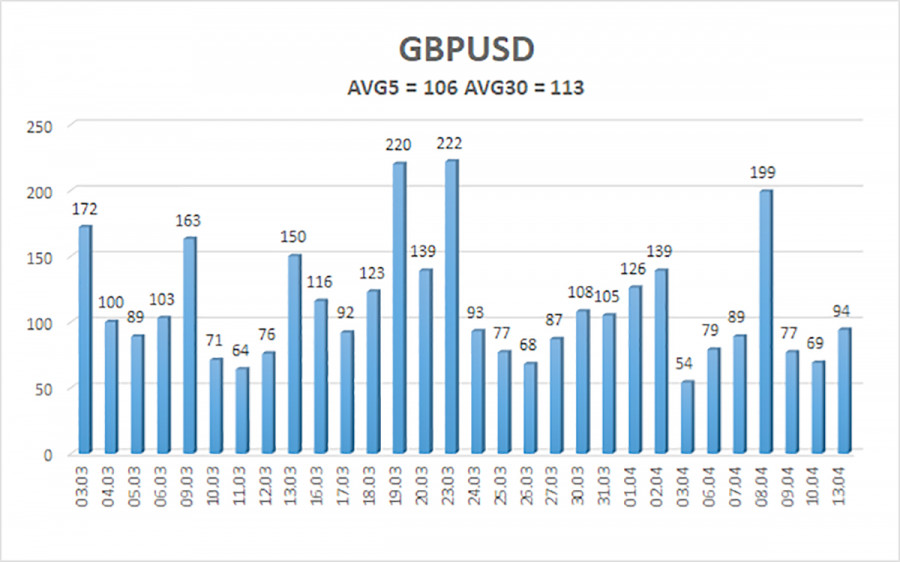
The average volatility of the GBP/USD pair over the last five trading days as of April 14 is 106 pips. For the GBP/USD pair, this value is considered "average." On Tuesday, April 14, we expect movement within a range limited by levels 1.3349 and 1.3561. The upper regression channel has turned downward, indicating a trend change. The CCI indicator has entered the overbought zone, warning of a possible downward correction. However, market movements still depend primarily on geopolitics rather than technicals.
S1 – 1.3428
S2 – 1.3367
S3 – 1.3306
R1 – 1.3489
R2 – 1.3550
R3 – 1.3611
The GBP/USD pair has begun to recover, but it has not yet managed to overcome its three latest local maxima. Trump's policies will continue to exert pressure on the US economy; therefore, we do not expect growth in the US dollar in 2026. Thus, long positions with targets at 1.3916 and above remain relevant when the price is above the moving average. If the price is below the moving average line, shorts can be considered with targets at 1.3306 and 1.3245 on geopolitical grounds. In recent months, nearly all news and events have turned against the British pound, leading to a prolonged downward trend. Geopolitics remains a key factor, but its influence is beginning to weaken.
Regression channels help determine the current trend. If both are directed in the same way, it indicates a strong trend.
The moving average line (settings 20.0, smoothed) defines the short-term trend and direction in which trading should proceed.
Murray levels serve as target levels for movements and corrections.
Volatility levels (red lines) indicate the probable price channel in which the pair is likely to trade over the next day, based on current volatility readings.
The CCI indicator's entry into the oversold area (below -250) or the overbought area (above +250) indicates that a trend reversal in the opposite direction is approaching.
ລິ້ງດ່ວນ

















 ຕິດຕໍ່ພວກເຮົາ