S&P Global Ratings revidovala výhled společnosti Hyatt Hotels Corp (NYSE:H) z negativního na stabilní a potvrdila její rating emitenta „BBB-“, a to s odkazem na zrychlený prodej aktiv a plánované snížení dluhu.
Ratingová agentura očekává, že společnost Hyatt získá z prodeje nemovitostí vlastněných společností Playa čistý výnos ve výši přibližně 1,7 miliardy USD, který bude použit na splacení odloženého termínovaného úvěru ve výši 1,7 miliardy USD, z něhož byla financována akvizice společnosti Playa na začátku tohoto roku.
Po splacení tohoto dluhu S&P Global Ratings předpovídá, že finanční páka společnosti Hyatt klesne v roce 2025 na přibližně 3,5x, což je výrazně méně než předchozí prognózy, které předpokládaly, že společnost bude nemovitosti Playa prodávat postupně až do roku 2027.
Po uzavření prodeje v průběhu tohoto roku uzavře společnost Hyatt 50leté smlouvy o správě 13 z 15 nemovitostí společnosti Playa. Společnost očekává, že tyto smlouvy o správě přinesou v roce 2026 hrubé poplatky ve výši 60 až 65 milionů dolarů, i když v roce 2025 bude přínos minimální, protože nové smlouvy budou podepsány až po uzavření transakce.
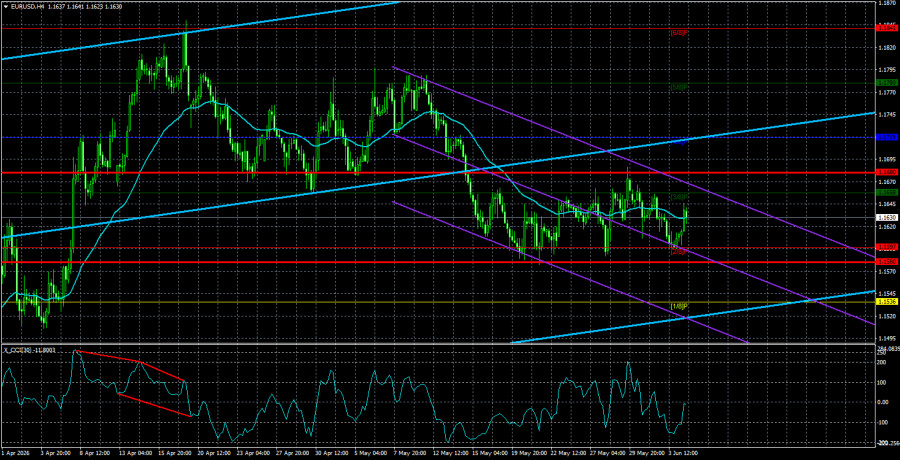
The EUR/USD currency pair continued to trade in the same manner on Thursday as it has for the past few weeks – with low volatility, a slight upward trend, and movement within a tight range. Under the current circumstances, we would not even pay attention to the upward slope, as 90% of the current movement is a range. Thus, we can only draw the same conclusions as yesterday and the day before: the market continues to ignore the macroeconomic and fundamental backdrop, is not ready to take on risk in any positions, and is waiting for a resolution to the conflict between Iran and the United States.
In principle, one does not need to be a genius analyst or trader to see the range on the 4-hour timeframe or even on the hourly timeframe. On the 4-hour timeframe, it is clearly visible that the price moves from 1.1597 to 1.1658 and back. Thus, market sentiment may change every day, but we would like to remind you that a classic range is a movement in its own right. A range forms not when news alternates between supporting bulls and bears. A range is an accumulation or distribution of previously opened positions. In simple terms, market makers during periods of range either accumulate new positions for a future trend or close old positions once the trend has concluded. Overall, a range does not answer exactly what large players are doing right now. However, it definitely does not indicate an ever-changing sentiment of traders. All we have seen in the last three weeks is merely market noise.
What important events occurred on Thursday? Essentially, none. Christine Lagarde did not report anything significant, Donald Trump continued to recite his mantra about soon reaching a good agreement with Iran, and Iran continued to deny any progress in negotiations and to wonder what the American president was talking about. In our view, it is foolish to say that the market was once again filled with optimism on Thursday due to geopolitics. It turns out that the market swings between depression and euphoria daily. This, to put it mildly, is unlikely.
Moreover, there are still no signs of an imminent deal between Washington and Tehran. Donald Trump continues to exude optimism, but he made similar statements two weeks ago. And nothing has changed since then. Iran has been denying serious progress in negotiations and the closeness of an agreement all this time, so the conflict in the Middle East is currently much closer to escalation than to resolution. The market continues to ignore fundamentals and macroeconomics; otherwise, the dollar would have shown significant growth this week (all macroeconomic data from across the ocean have been positive), and last week, the euro would have risen, as the likelihood of tightening European Central Bank monetary policy sharply increased. But all we see is a range, and this movement does not need to be explained every day by picking a suitable factor from today's list.
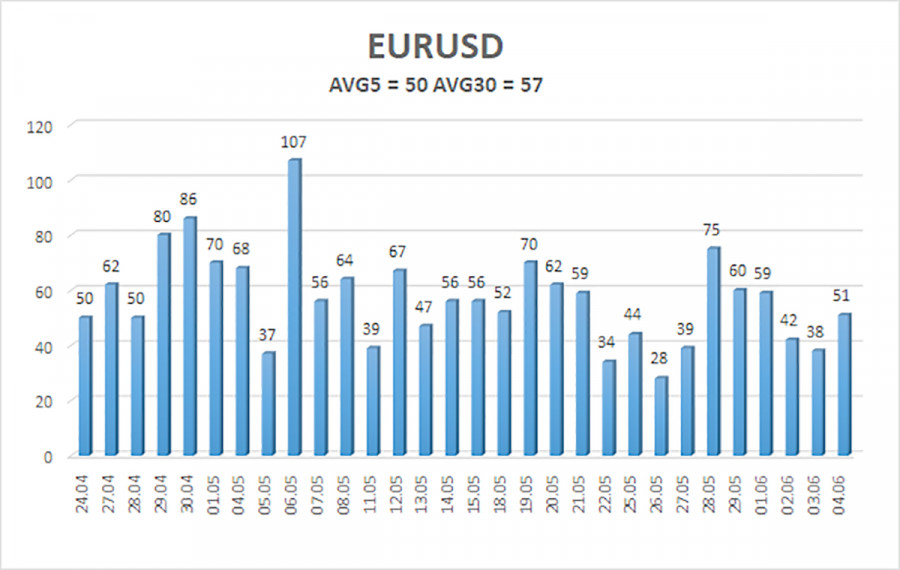
The average volatility of the EUR/USD currency pair over the last five trading days as of June 5 is 50 pips, characterized as "medium-low." We expect the pair to move between 1.1580 and 1.1680 on Friday. The upper linear regression channel has turned upward, indicating a change in trend to an upward direction. In fact, the upward trend for 2025 could have resumed back in March. The CCI indicator has entered the overbought zone and formed two "bearish" divergences, which warned of the beginning of a downward correction that is still not complete.
S1 – 1.1597
S2 – 1.1536
S3 – 1.1475
R1 – 1.1658
R2 – 1.1719
R3 – 1.1780
The EUR/USD pair continues its downward movement, which is presumably a correction within the global upward trend. The global fundamental background for the dollar remains extremely negative, and only the geopolitical factor regularly supports it. When the price is below the moving average, short positions can be considered with targets of 1.1580 and 1.1536. Above the moving average line, long positions are relevant with targets of 1.1680 and 1.1719. The market continues to detach from geopolitical factors, but in recent weeks, the dollar has been in demand as hopes for peace in the Middle East have diminished. Movements at this time are weak, so it is better to trade on smaller timeframes.
Linear regression channels help determine the current trend. If both are directed in one direction, it means the trend is currently strong;
The moving average line (settings 20,0, smoothed) determines the short-term trend and the direction in which trading should currently be conducted;
Murray levels are target levels for movements and corrections;
Volatility levels (red lines) indicate the likely price channel in which the pair will spend the next 24 hours based on current volatility indicators;
The CCI indicator – its entry into the oversold area (below -250) or the overbought area (above +250) indicates that a trend reversal in the opposite direction is approaching.

ລິ້ງດ່ວນ



















 ຕິດຕໍ່ພວກເຮົາ