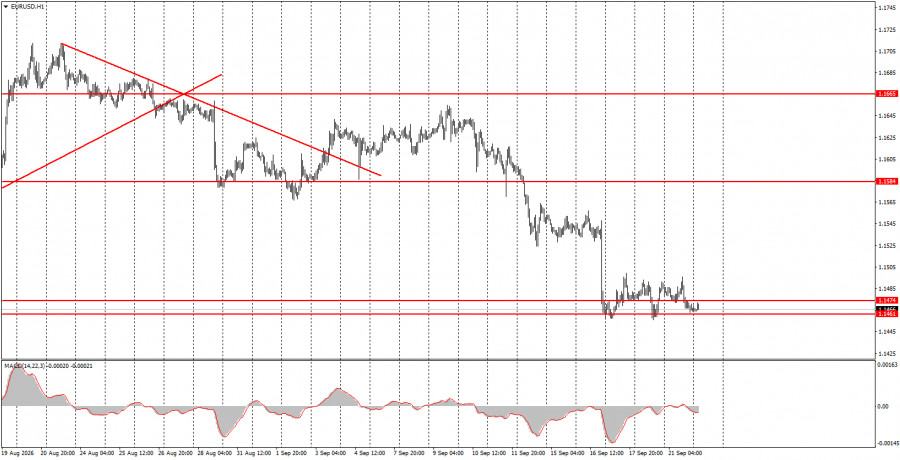
The EUR/USD pair on Monday again tried to start an upside correction—with the same lack of success as on Friday and Thursday. Traders have so far been unable to break through the 1.1461–1.1471 support area, but they also cannot push the pair higher. In other words, after two weeks of decline, EUR/USD cannot even mount a modest correction, which is a very poor sign for the euro. Traders are not taking profits on previously opened short positions, so any additional selling pressure could break the 1.1461–1.1471 zone and trigger a new leg down. On Monday, the macro and fundamental calendar was essentially empty, so volatility was low as we warned. Overall, the market is trading only around the most important events and ignoring the rest — even European Central Bank meetings at times. From a technical perspective, a corrective move should begin this week at the latest, but in the bigger picture, bears still have the capacity to push the pair lower.
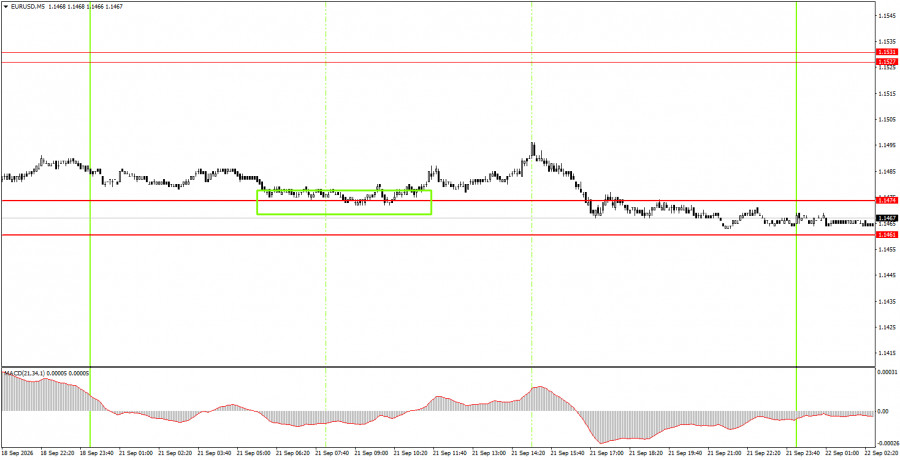
On the 5-minute timeframe on Monday, one buy signal formed, but novice traders could reasonably ignore it since intraday movement was virtually nonexistent. During the European session, price bounced from the 1.1461–1.1471 area and... that was it. No meaningful upside move materialized.
On the hourly timeframe, EUR/USD continues a downward trend that is now a full-blown trend. Considering recent months' events, we do not think the euro should collapse like a stone, but the market's primary focus remains Federal Reserve policy, which this week turned significantly more supportive of the US dollar. However, that factor cannot buoy the dollar forever.
On Tuesday, novice traders may open short positions targeting 1.1366–1.1377 if price consolidates below 1.1461–1.1474. Long positions can be opened targeting 1.1527–1.1531 in case of a bounce from the 1.1461–1.1474 zone.
On the 5-minute timeframe, consider the levels 1.1267–1.1275, 1.1366–1.1377, 1.1461–1.1474, 1.1527–1.1531, 1.1584–1.1594, 1.1655–1.1665, 1.1745–1.1754. No major events or releases are scheduled in the euro area or the US on Tuesday, so traders will again have little to react to during the day. We do not expect the weekly ADP or the EU consumer-confidence index to provoke any notable market reaction.
Price levels (areas) of support and resistance serve as targets for opening buy or sell trades or as sources of signals.
Red lines indicate channels or trend lines that show the current trend and the preferred trading direction.
The MACD indicator (14,22,3) — the histogram and signal line — is an auxiliary indicator that can also provide signals.
Important speeches and reports (listed in the news calendar) can significantly influence currency pair movements. Therefore, during their release, traders should approach trading with utmost caution, or exit the market to avoid sudden reversals against the preceding move.
Beginner forex traders should remember that not every trade can be profitable. Developing a clear strategy and practicing money management are key to long-term success in trading.

ລິ້ງດ່ວນ



















 ຕິດຕໍ່ພວກເຮົາ