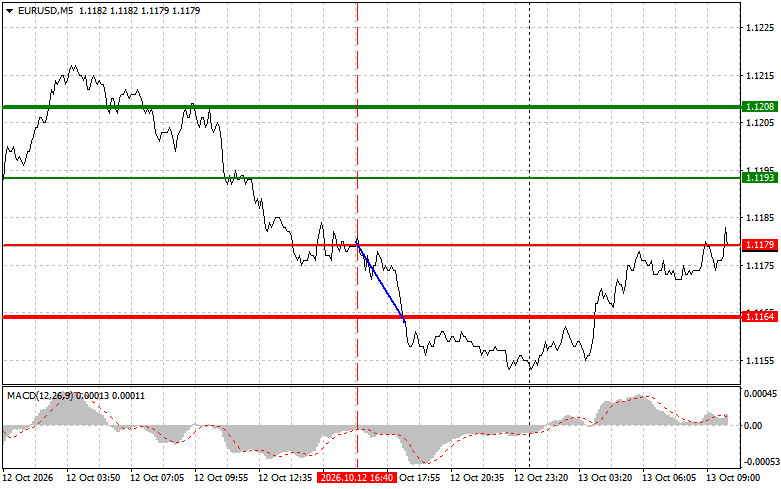
A price test at 1.1179 occurred as the MACD indicator began moving down from the zero line, confirming a correct entry point to sell the euro. As a result, the pair fell toward the target area 1.1164.
Yesterday was a losing day for the euro. Beth Hammack's remarks were an unpleasant reminder that rates will rise. The main point of her speech was that inflationary pressure in the US is broad and not limited to energy. Hammack explained this with two reasons. Tariffs raise costs in waves, and building artificial intelligence infrastructure increases the cost of components and equipment. In addition, she said companies are already pricing in increases above their own cost growth, so anchored inflation expectations cannot be taken for granted.
The euro calendar is almost empty today, but one figure could shift market sentiment: Germany's September inflation, with both the regular consumer-price index and the harmonized EU measure due. To understand how strong the result must be, recall August: annual inflation then was 2.9% versus 2.8% in July, and energy jumped about 10.5% year-on-year. I believe that for EUR/USD to recover we need not just a match with the forecast but a noticeable acceleration. Such a result would strengthen expectations of further European Central Bank action and give euro buyers an argument after the fall to monthly lows. If the figures disappoint, the market will return to questions about how hawkish the Fed will be, and pressure on the euro will persist.
For the intraday strategy, I will mainly rely on Scenarios 1 and 2.
Scenario 1: Buy the euro today near 1.1185 (green line on the chart), targeting 1.1208. I plan to exit at 1.1208 and also sell EUR there, aiming for a 30–35 pip move from the entry. Expect euro gains today only after strong German data. Important: before buying, ensure MACD is above zero and only beginning to rise from it.
Scenario 2: Also consider buying if price tests 1.1173 twice while MACD is in the oversold area. That would limit downside potential and trigger a reversal upward. Expect moves to the opposite levels 1.1185 and 1.1208.
Scenario 1: Plan to sell the euro after it reaches 1.1173 (red line on the chart). The target is 1.1158, where I plan to exit and immediately buy in the opposite direction (aiming for a 20–25 pip reversal from that level). Strong pressure on the pair is unlikely to return today. Important: before selling, ensure MACD is below zero and only beginning to decline from it.
Scenario 2: Also consider selling if price tests 1.1185 twice while MACD is in the overbought area. That would limit upside potential and trigger a reversal downward. Expect declines toward the opposite levels of 1.1173 and 1.1158.
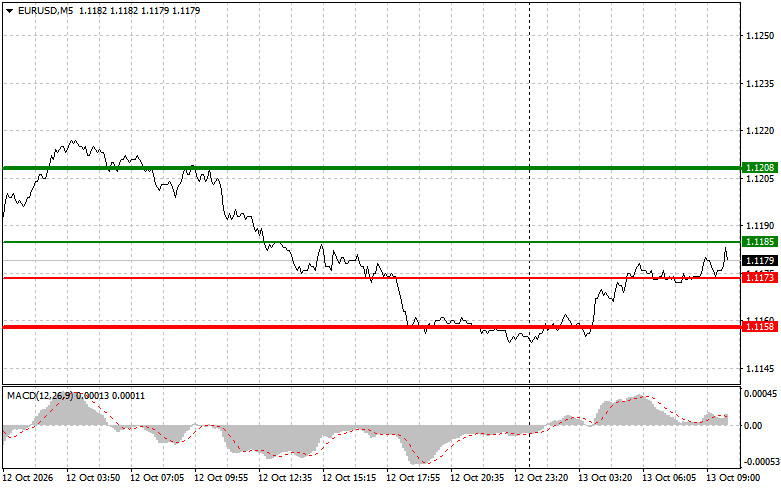
Thin green line — entry price where you can buy the instrument.
Thick green line — approximate price where you can place Take Profit or manually lock in profits, because further upside above this level is unlikely.
Thin red line — entry price where you can sell the instrument.
Thick red line — approximate price where you can place Take Profit or manually lock in profits, because further downside below this level is unlikely.
MACD indicator. When entering the market, it's important to consider overbought and oversold zones.
Important. Novice Forex traders must be very cautious when deciding to enter the market. It is best to stay out before major fundamental reports to avoid getting caught in sharp price swings. If you decide to trade during news releases, always place stop orders to minimize losses. Without stop orders, you can quickly lose your entire deposit, especially if you don't use money management and trade large volumes.
Remember: successful trading requires a clear trading plan, like the example above. Spontaneous trade decisions based solely on the immediate market situation are, by definition, a losing strategy for an intraday trader.
ລິ້ງດ່ວນ



















 ຕິດຕໍ່ພວກເຮົາ