The Strait of Hormuz is once again under blockade. If not fully, then at least partially, which does not change the essence of the situation. Even if the strait remains formally open, it is unlikely that commercial vessels will navigate through it amid enemy rockets and drones. According to the latest reports, Iran is demanding that ships pass through its territorial waters and also intends to charge fees for using the strait. Washington's position is different – the strait must remain free and safe for all. Thus, at this time, there are three unresolved issues between Iran and the United States, in each of which neither side is willing to make concessions.
Firstly, there is the Strait of Hormuz. Secondly, there is Iran's nuclear energy. Thirdly, the war between Lebanon and Israel, which was "forgotten" during peace negotiations in the Middle East. On Saturday, Iran's Advisory Council called for the closure of the Strait of Hormuz if Israel does not cease its attacks on Lebanon. It should be noted that on Friday, Israel and Lebanon signed a framework agreement for a ceasefire; however, Hezbollah rejected it and stated that the conflict continues. Another attempt at a ceasefire failed.
Additionally, it became known on Sunday that Iran attacked a vessel near Oman last Thursday, and earlier, Tehran prohibited the use of the passage off the coast of Oman, demanding that vessels navigate only through Iranian maritime routes. Donald Trump called this event a violation of the ceasefire and ordered strikes on Iranian positions. Consequently, fighting has continued since Friday.
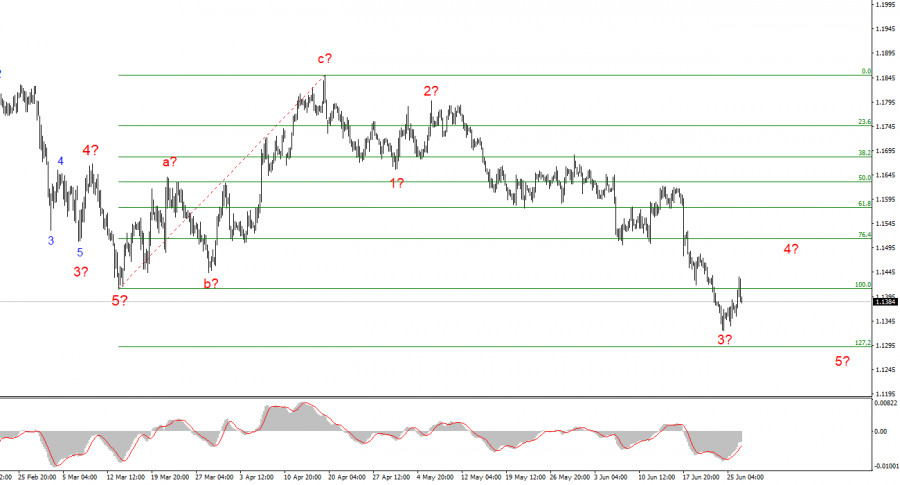
Next week, clashes in the Strait of Hormuz are likely to continue, and the United Maritime Information Center has raised the threat level to "significant." Based on all the above, it can be concluded that traffic in the Strait of Hormuz is unlikely to recover anytime soon. At the current moment, one cannot even confidently state that the conflict is over. And if it is not over, that means it continues, just lying dormant like a volcano. The level of uncertainty will remain high in the near future, which signifies sharp price fluctuations in either direction as soon as the geopolitical backdrop changes. At this point, I recommend basing strategies on the wave picture, which suggests the formation of yet another downward wave for both instruments.
Based on the analysis of EUR/USD, I conclude that the instrument remains within an upward segment of the trend, while in the short term, it is within a downward segment. In my opinion, now is a good time to try forming long positions, but the instrument may drop much lower than 14 figures within wave C. If this assumption is correct, it would be better to wait a little longer, at least for wave 5 in C. However, wave analysis often brings surprises, so I would start adjusting to buying now.
The wave picture for the GBP/USD instrument has become clearer. Currently, the instrument has constructed three waves down; the wave analysis for EUR/USD has changed, so three waves have also been constructed there. Consequently, the British pound may resume its decline within wave 5 in C after a small correction in wave 4. One way or another, the downward wave formation may conclude soon, and the news background does not provide unconditional support for the U.S. currency. The unsuccessful attempt to breach the 1.3157 level, which corresponds to 100% on the Fibonacci scale, suggests the instrument's poised to rise. The pound's issue again lies in geopolitics.
QUICK LINKS


















 Contact Us