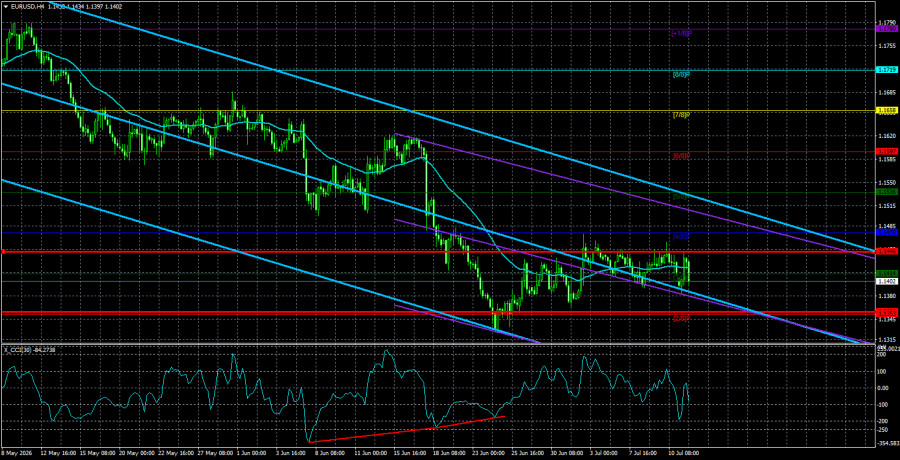
The EUR/USD pair has effectively remained stagnant since the Friday before last, trading within the range of 1.1391-1.1461. This means we are dealing with yet another low-volatility flat. As a result, it can now be stated unequivocally that the fundamentals, macroeconomics, and geopolitics are either being ignored or are absent. In practice, this is indeed the case. Last week, only one more-or-less significant report was released—the ISM services sector business activity index in the U.S. There were no fundamental events apart from the formal Fed minutes. The market is desperately ignoring geopolitics, simply fatigued from the constant "swings" in the Middle East.
To summarize briefly, Iran and the U.S. periodically violate the terms of the ceasefire, attack each other, and then blame one another for the ceasefire's breakdown. And that's it. There are no negotiations between Tehran and Washington happening at this time. A meeting between American and Iranian delegations was scheduled for July 11 but clearly did not take place. The positions of Iran and the U.S. on key issues remain unchanged, leaving us wondering why the memorandum of understanding was even necessary and what kind of mutual understanding is being discussed. The parties have not moved an inch toward peace in nearly a month since the memorandum was signed. Negotiations are continually breaking down and are now completely at a standstill. Neither Iran nor the U.S. is willing to concede on key issues. What is the point of further negotiations—or even any semblance of them?
However, as we mentioned, the market is currently not reacting to geopolitics. What might it react to this week? The U.S. inflation report, set to be released today, immediately comes to mind. It is expected that inflation will slow to 3.8%–3.9%, though in reality, we could see a very different figure. After all, oil prices have dropped to $70–$80 per barrel in recent weeks, suggesting we should see some deceleration in price growth. However, now that the chances for long-term peace in the Middle East are again heading toward zero, even a slowdown in inflation will mean almost nothing.
If the conflict were truly resolved, one could anticipate a gradual decrease in inflation without harsh measures from the Federal Reserve. As it stands, we can only expect a slight decline in consumer prices, which is unlikely to affect the overall dynamic. Thus, the further Iran and the U.S. are from a new agreement, the closer the Fed gets to tightening monetary policy.
Should we expect a new rise in the dollar? In our view, it is possible, as the market continues to seize any opportunity to buy U.S. currency while ignoring factors in favor of the euro. Therefore, a new rise would be illogical, but it cannot be ruled out. It should be noted that if the Strait of Hormuz is closed again and Iran and the U.S. fail to reach an agreement, inflation will remain high/increase not only in America but also in the European Union. Consequently, the European Central Bank will also be forced to continue raising rates. However, will the market take this factor into account?
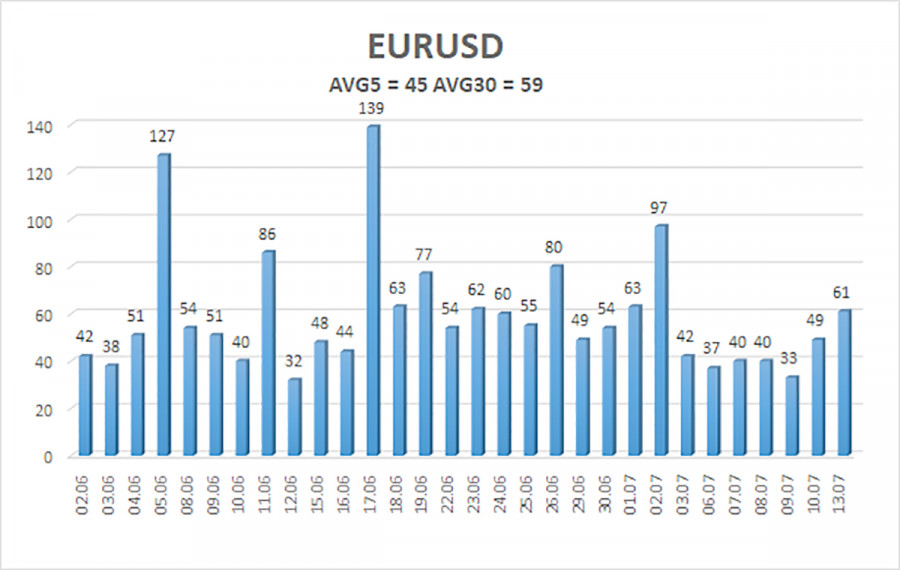
The average volatility of the EUR/USD pair over the last five trading days as of July 14 is 45 pips and is characterized as "low." We expect the pair to move between levels 1.1356 and 1.1446 on Tuesday. The upper linear regression channel is directed downward, indicating the continuation of the bearish trend. The CCI indicator has entered the oversold territory and formed two "bullish" divergences, warning of a possible end to the downward trend.
The EUR/USD pair maintains a downward trend, presumably a correction within a broader upward trend, as is clearly evident on the daily or weekly timeframe. The global fundamental backdrop for the dollar remains negative, but in 2026, first geopolitics and then the Fed's hawkishness have provided strong support for the U.S. currency. When the price is below the moving average, consider shorts targeting 1.1353 and 1.1292. Above the moving average line, consider long positions targeting 1.1475 and 1.1536. Bears are currently extremely strong for no apparent reason.
QUICK LINKS



















 Contact Us