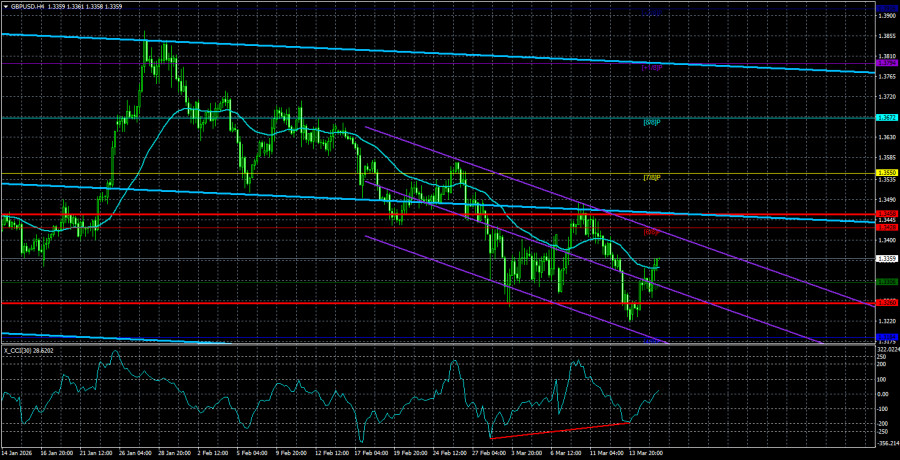
The GBP/USD currency pair also traded quite calmly on Tuesday, with no downward momentum. Yesterday, another "bullish" divergence was formed in the CCI indicator after at least two entries into the oversold area. It is worth noting that divergences and entries into overbought/oversold areas are trend signals, not counter-trend signals. In other words, if these signals are formed against the trend, they indicate a correction. The trend on the 4-hour time frame is currently downward.
However, despite this trend, it is driven solely by a geopolitical factor. We have repeatedly noted that the market continues to ignore not only macroeconomic data but also many other factors that clearly weigh on the US dollar. But even the macroeconomic data show that the current growth of the US currency is not entirely justified. Some might assume that following the conflict in Iran, the US would reap enormous profits from selling oil and gas, but it should be noted that Washington will also be spending significant amounts on the war itself. For example, in the first week, the US spent around $20 billion on military operations in the Middle East. Besides financial losses, there will also be costs in lives and equipment among American soldiers. Furthermore, what benefit is there from additional profits from oil and gas sales if the US budget remains in deficit, the trade balance is negative, and national debt continues to break records? Last year, to address these issues, Trump initiated a trade war. Did it help?
Thus, we did not consider and do not consider the geopolitical factor as a source of long-term support for the US currency. For the time being, it will support the dollar only because the whole world continues to view it as a "safe haven." But this cannot last forever. Meanwhile, this evening, another Fed meeting will take place, which has raised many questions in the past two weeks. Recall that in January, the "dot plot" signaled the FOMC committee's readiness for two rounds of easing in 2026. However, since then, two NonFarm Payroll reports, two unemployment reports, and two inflation reports have been released...
While the January labor market data appeared quite positive, February's confirmed that it was a mere error or seasonal discrepancy. The US labor market remains in a state of confusion due to Trump's policies, and the current inflation rate does not raise alarm. Under these circumstances, we would assume the Fed would be prepared for more aggressive monetary easing than anticipated in January. However, the market holds the opposite view. Traders believe that the war in Iran and rising energy prices will provoke a sharp rise in inflation. They are likely correct, which brings the Fed back to the dilemma: save the labor market or control inflation? This evening, we will find out which way the majority of Fed representatives will vote. Depending on the central bank's stance, the dollar will continue to move north or south. However, the factor of Fed monetary policy is now even more short-term. Geopolitics is far more important to the market.
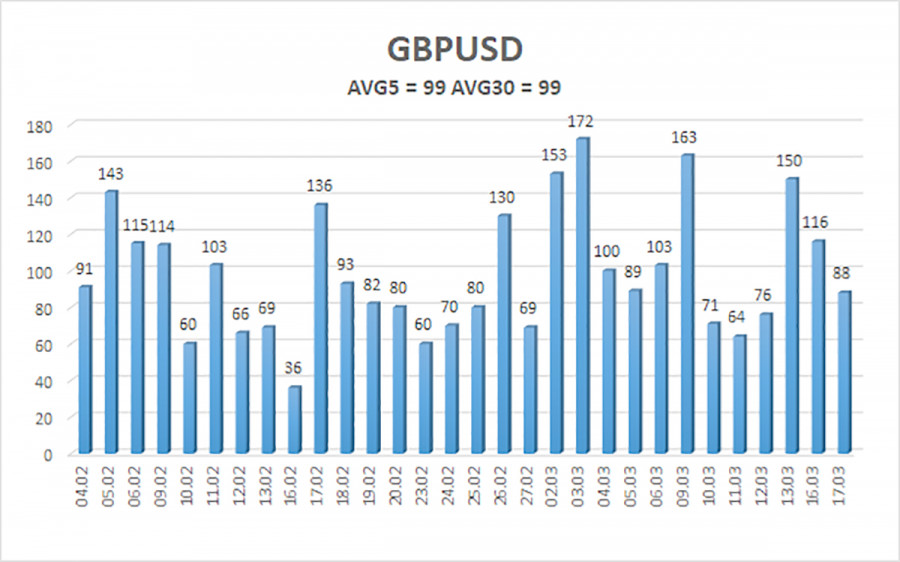
The average volatility of the GBP/USD currency pair over the last five trading days is 99 pips. For the pound/dollar pair, this value is considered "average." On Wednesday, March 18, we expect movement within the range between 1.3260 and 1.3458. The upper linear regression channel has leveled off, indicating a trend reversal. The CCI indicator has entered the oversold zone twice, signaling the completion of the correction and the formation of a new "bullish" divergence.
S1 – 1.3306
S2 – 1.3184
S3 – 1.3062
R1 – 1.3428
R2 – 1.3550
R3 – 1.3672
The GBP/USD currency pair has been correcting for a month and a half, but its long-term prospects remain unchanged. Trump's policies will continue to pressure the US economy, so we do not expect the US currency to grow in 2026. Therefore, long positions with a target of 1.3916 and above remain relevant as long as the price is above the moving average. If the price is below the moving average line, small short positions can be considered with targets at 1.3260 and 1.3184 based on geopolitical factors. In recent weeks, almost all news and events have turned against the British pound, prolonging the correction.
Linear regression channels help determine the current trend. If both are directed in the same way, then the trend is strong at the moment;
The moving average line (settings 20,0, smoothed) determines the short-term trend and the direction in which to trade;
Murray levels – target levels for movements and corrections;
Volatility levels (red lines) – the probable price channel in which the pair will move in the upcoming day, based on current volatility readings;
The CCI indicator – its entry into the oversold area (below -250) or the overbought area (above +250)- indicates that a trend reversal is nearing in the opposite direction.

PAUTAN SEGERA



















 Hubungi Kami