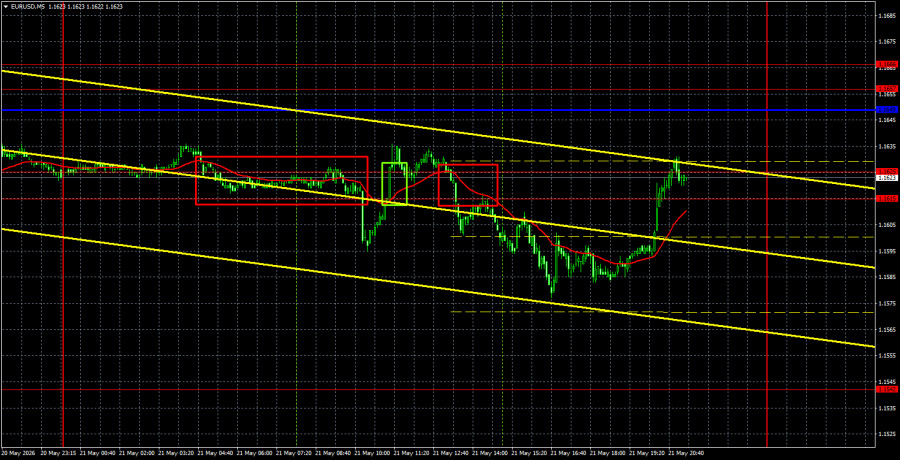
The EUR/USD currency pair fell again on Thursday. This time, unexpectedly for many, the market reacted to the macroeconomic data from the Eurozone that we discussed yesterday. There was little hope that the business activity indices would be taken into account by the market, but once in a while, even a broken clock is right. Business activity in the services and manufacturing sectors of Germany and the EU significantly decreased in May, leading to the decline of the euro throughout the day. However, even in such a seemingly straightforward logical chain, one cannot be entirely sure. It is quite possible that the market reacted again to negative geopolitical news, which there is no shortage of. The fact remains: the primary reason for the euro's decline is geopolitics. The market currently does not believe in the success of negotiations between the U.S. and Iran. However, this factor may already be priced in, and for further U.S. dollar appreciation, a full escalation of the conflict is needed.
From a technical perspective, the downward trend remains unquestionable on the hourly timeframe. This trend will persist until the price surpasses the Senkou Span B line. Given the constant shifts in geopolitical dynamics, we would not be surprised if yesterday's decline in the euro is met with a resurgence today. Geopolitics continues to sway all financial markets back and forth.
On the 5-minute timeframe on Thursday, three trading signals were generated. The only buy signal in the area of 1.1615-1.1625 should not have been acted upon due to the proximity of the Kijun-sen line. The two sell signals reinforced each other, allowing for a profit of around 10-15 pips by the end of the day. Volatility throughout the day was again low, with choppy movements.
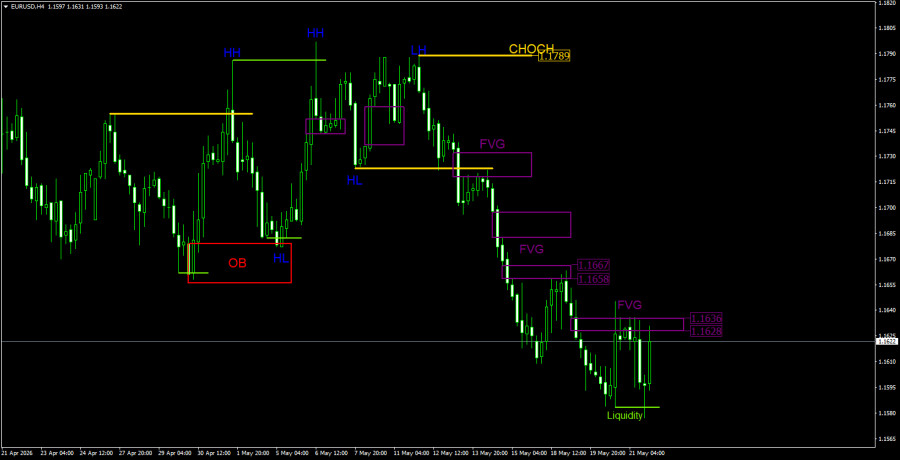
On the 4-hour time frame, according to the ICT trading system, on Tuesday, the price worked through the area of 1.1628-1.1636, which was a "bearish" FVG, and formed a sell signal that could definitely be executed. During the decline on Wednesday, a new bearish FVG was formed in the area of 1.1628-1.1636, which reacted on Thursday and formed another sell signal. Thus, during the current downward trend, traders had at least three opportunities to open profitable short positions. On Thursday evening, the pair removed buy liquidity from the previous low, and the decline in quotes ended. The pair's movement on Friday will still depend on geopolitics. If it does not interfere, we would expect the euro to rise.
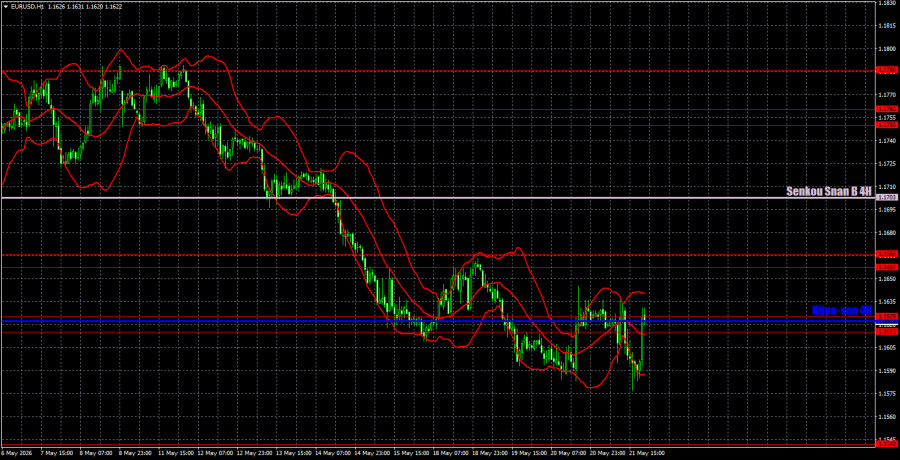
On the hourly time frame, the EUR/USD pair continues to form a downward trend. The situation in the Middle East remains tense; it is not getting worse, but negotiations have once again hit a dead end, which allows the dollar to show moderate growth. In the near future, the pair's movements will depend on geopolitics. If no new signs of escalation in the Middle East appear, the dollar will begin to lose positions.
As of May 22, we highlight the following levels for trading: 1.1362, 1.1426, 1.1542, 1.1615-1.1625, 1.1657-1.1666, 1.1750-1.1760, 1.1786, 1.1830-1.1837, 1.1907-1.1922, as well as the Senkou Span B line (1.1703) and the Kijun-sen line (1.1622). The lines of the Ichimoku indicator may move during the day, which should be considered when determining trading signals. Do not forget to set the stop-loss order to break even if the price has moved in the right direction by 15 pips. This will protect against possible losses if the signal turns out to be false.
On Friday, there are no major events or reports scheduled in the European Union (except for the secondary German indexes), while in the US, the second estimate of the University of Michigan consumer sentiment index will be published. Thus, all reports for the day will have no impact on the pair's movement.
Today, traders can open new short positions targeting 1.1542 if the price bounces from the 1.1615-1.1625 area. Long positions can be opened if the price holds above the 1.1615-1.1625 area, targeting the 1.1657-1.1666 area and the Senkou Span B line. On the 4-hour time frame, a new "bearish" pattern is required to open short positions, while for long positions, a break of the structure and the formation of bullish patterns is needed.

PAUTAN SEGERA



















 Hubungi Kami