Mark Zuckerberg by měl vystoupit jako hlavní svědek v neobvyklém soudním sporu o 8 miliard dolarů, který začíná tento týden. Generální ředitel Meta je obviněn z provozování Facebooku jako nelegálního podniku, který umožňoval shromažďování údajů uživatelů bez jejich souhlasu.
Akcionáři společnosti Meta Platforms (NASDAQ:META), mateřské společnosti Facebooku, Instagramu a WhatsApp, zažalovali Zuckerberga a další současné a bývalé vedoucí pracovníky společnosti s tím, že opakovaně porušovali dohodu z roku 2012 mezi Facebookem a Federální obchodní komisí o ochraně údajů uživatelů.
Případ se datuje do roku 2018, kdy vyšlo najevo, že k údajům milionů uživatelů Facebooku získala přístup společnost Cambridge Analytica, dnes již neexistující politická poradenská firma, která pracovala pro úspěšnou kampaň Donalda Trumpa v amerických prezidentských volbách v roce 2016.
Akcionáři požadují, aby Zuckerberg a další žalovaní společnosti uhradili více než 8 miliard dolarů na pokutách a dalších nákladech, které Meta zaplatila po odhalení skandálu Cambridge Analytica, včetně rekordní pokuty ve výši 5 miliard dolarů, kterou Facebooku uložila FTC v roce 2019 za porušení dohody z roku 2012.
Mezi žalované v tomto případě patří bývalá provozní ředitelka Sheryl Sandbergová, venture kapitalista a člen představenstva Marc Andreessen, stejně jako bývalí členové představenstva Peter Thiel, spoluzakladatel Palantir Technologies (NASDAQ:PLTR), a Reed Hastings, spoluzakladatel Netflixu (NASDAQ:NFLX).
Zuckerberg a ostatní obžalovaní, kteří se odmítli vyjádřit, označili obvinění v soudních spisech za „extrémní tvrzení“. Společnost Meta, která není obžalovaná, se rovněž odmítla vyjádřit.
Lagarde also noted that the effects of rising energy prices could manifest for a considerable time. In other words, inflation may not fully react to a specific rise in oil prices within a single month. It will need more time. If the conflict between Iran and the US drags on (though how much longer could it be?), inflation will continue to accelerate and spread across all sectors of the economy, including services and food prices. The European Central Bank expects inflation in the EU to begin slowing no earlier than the second half of 2027, and only with a tightening of monetary policy.
Regarding the economy, Lagarde maintains a moderately optimistic position. She believes that the European economy will continue to show moderate growth, but the conflict in the Middle East could slow it down. Disruptions in oil and gas supply may decrease incomes for European citizens, leading to a drop in consumer spending as well as reduced investments.
In summary, I can make the same conclusions as I did prior to the ECB meeting. Firstly, monetary policy will depend on the conflict in the Middle East, the status of the Hormuz and Bab-el-Mandeb Straits, and oil prices. Secondly, decisions will be made based on the latest reports on inflation, economic growth, and business activity. Thirdly, the ECB will not rush into action, as this will slow down the European economy. Fourthly, if necessary, the ECB is ready to raise interest rates. Fifthly, this information is of no interest to market participants.
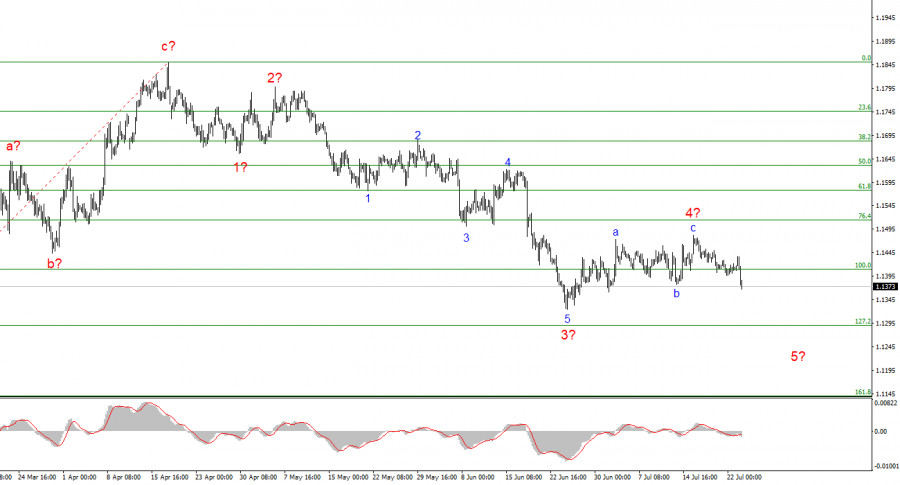
In my view, the outcomes of the ECB meeting cannot be deemed "dovish." Consequently, there were no reasons for the market to sell off the euro on Thursday. Nonetheless, we saw a decline in the euro, which fully corresponds to the wave picture. In this case, after the completion of wave 5 in C, we could see a much more logical rise in the EUR/USD instrument.
Certainly, the Federal Reserve's position on monetary policy should also be taken into account. However, I would like to remind you that at the last meeting, the FOMC Committee had not even hinted at a possible rate hike before the market rushed to buy dollars. Therefore, at least one round of policy tightening has already been priced in. In this case, the dollar continues to rise but is losing its supportive factors. Geopolitics is providing it with assistance, but how much longer will demand for the US currency increase based solely on one geopolitical conflict? In my view, the market has long needed to move on.
Based on my analysis of EUR/USD, I conclude that the instrument remains within an upward trend segment, while in a shorter-term perspective, it is within a downward trend segment. In my opinion, it is a good time to consider opening long positions, but the instrument may still drop to the 13 figure as part of wave 5 in C. Wave analysis often brings surprises, so I would start to reassess towards buying.
The wave analysis for the GBP/USD instrument has taken on a rather complex form. Currently, the instrument has built three waves down, while EUR/USD could form five waves. Therefore, the British pound could also form one more wave down, just like the euro, but this wave may be the second one within a new upward trend segment. Thus, the divergence in wave patterns between the euro and the pound will exist but will likely be insignificant. Based on this, I expect a downward pullback in the near term, followed by the formation of a new upward trend segment, with initial targets located around the 37-38 figures.
PAUTAN SEGERA













 Hubungi Kami