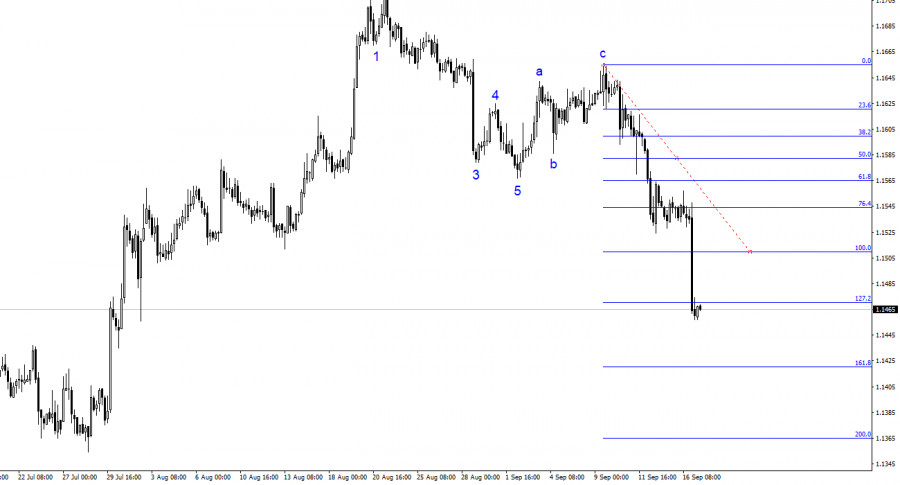
I advise beginner traders to trade based on the most common wave structures. Anyone who has studied wave analysis, even superficially, knows that impulsive structures consist of five waves, while corrective structures consist of three waves. After an impulsive structure is completed, a corrective structure begins, and vice versa. Of course, standard structures do not always occur in the real market, but when they do, beginner traders can use them as a basis for trading.
At present, we are dealing with a structure that may develop into a five-wave pattern. We have seen a clear three-wave correction, which means that the formation of a new impulsive structure has begun. The first wave of this structure was quite extended and contains no internal corrective waves. Therefore, a corrective wave may begin in the near future. After it is completed, the decline in EUR/USD may continue toward the target around 1.1420, which corresponds to 161.8% of the size of the first wave according to Fibonacci.
I would also like to remind you that the fundamental backdrop often has a strong influence on wave structures. Yesterday provided clear evidence of this. The instrument was apparently preparing to form an upward corrective wave, but the outcome of the Fed meeting was not entirely what the market had expected. As a result, the decline continued, and the corrective wave did not form.
In recent weeks, the fundamental backdrop has focused mainly on the Fed meeting and the future course of the US regulator. Yesterday evening, it became clear that Kevin Warsh was not prepared to adopt the position of Donald Trump, who has been calling for lower interest rates for a year and a half and has also been trying to dismiss Fed governors who are not prepared to vote for policy easing. However, Donald Trump was unable even to dismiss Lisa Cook because the US Supreme Court cannot simply make decisions at the direction of the White House.
Moreover, after being appointed Fed Chair, Kevin Warsh effectively came out from under Donald Trump's control and is free to make the decisions he considers appropriate. The position of the FOMC should also be noted. All 12 members voted to tighten policy, so even if Warsh had wanted to lower the rate, he would have been in the minority. Therefore, quite simply, even if Kevin Warsh wanted to, he would not be able to change policy with eleven hawkish governors opposing him. This means that the Fed is moving toward tighter policy as part of its efforts to return inflation to the 2% target.
Based on my analysis of EUR/USD, I conclude that the instrument remains within a downward trend segment that may develop into either a three-wave or five-wave structure. After a decline of 200 basis points, it is reasonable to expect a corrective wave to form. A successful attempt to break above 1.1470, which corresponds to the 127.2% Fibonacci level, would indicate that the market is ready to take partial profits on short positions, which could lead to a rise toward 1.1509, corresponding to the 100.0% Fibonacci level. The longer the price remains below 1.1470, the higher the probability of a continued decline toward 1.1420.
SZYBKIE LINKI
















 Skontaktuj się z ForexMart