
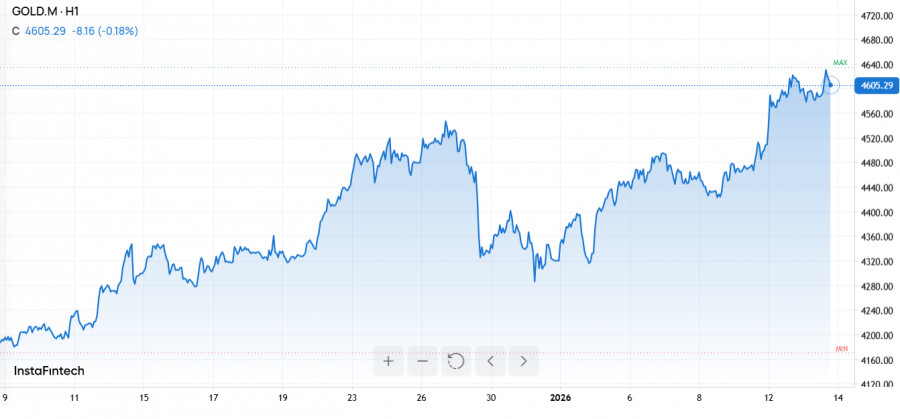
Global financial markets reacted with a sharp spike in volatility to escalating geopolitical tensions around Greenland. On Monday, January 12, 2026, the price of gold reached an unprecedented $4,600 per ounce, and European defense stocks hit new all-time highs, posting a weekly gain of 10% — the best performance in five years.
The panic among investors was triggered by increasingly realistic-seeming threats from former US President Donald Trump to seize control of the Arctic territory — either by purchase or by force.
The market reaction reflects growing concern that such actions by Washington could not only undermine stability in the Arctic but also split NATO, threatening the international order established after World War II. European Commissioner for Defence and Space Andrius Kubilius said on Monday that a forcible US takeover of Greenland would mean "the end of NATO" and lead to extremely negative consequences for society.
Until recently, Trump's statements about Greenland were perceived as rhetoric. However, everything changed after Operation "Absolute Resolve" — a sudden raid by US military forces that resulted on January 3, 2026, in the capture of Venezuelan President Nicolas Maduro. That step demonstrated the US's willingness to put previously voiced threats into action, instantly raising perceived risks related to the Arctic territory.
"If you look at gold prices, they are simply screaming that markets are worried about geopolitical risks," noted Matthew Miskin, co-chief investment strategist at Manulife John Hancock Investments.
Against this backdrop, gold rose more than 4% over the past week, while shares of European defense companies showed impressive gains: German tank maker Rheinmetall climbed 19%, and Swedish Saab jumped 22%.
Analysts emphasize that the consequences of a possible conflict over Greenland would extend far beyond the Arctic. "This would call into question the global order that was largely established since Bretton Woods II or the end of World War II, when NATO was created," said Stephen Kolano, chief investment officer at Integrated Partners.
Denmark, which formally controls Greenland, reacted sharply. Prime Minister Mette Frederiksen called the current situation "a defining moment" and stressed the country's commitment to international law and the principle of self-determination. Leaders of France, Germany, Italy, and the United Kingdom voiced support for Copenhagen, unanimously stating that Greenland's future must be decided only by its people.
Despite the rapid rise in gold and defense stocks, broad market indices remain near record highs, underscoring the difficulty of balancing portfolios amid low-probability yet extremely high-impact geopolitical shocks.
In the event of real military intervention by the US, the consequences could be massive. As Jack Ablin, chief investment officer at Cresset Capital, warned, such a development "would be a major event that would trigger risk aversion in equity markets and weaken the dollar."
The current situation creates opportunities for tactical positioning. First, gold remains a reliable safe-haven asset: buying physical gold, precious-metal ETFs, or futures can protect a portfolio from a potential stock-market crash. Second, European defense stocks such as Rheinmetall and Saab continue to attract attention — their gains could accelerate in case of further escalation.
Finally, traders may consider short positions in the dollar or options on currency volatility if the US takes aggressive steps, which analysts predict would lead to a weakening of the American currency. However, given the low base probability of this scenario, it is important to diversify risks and avoid excessive leverage.
RÁPIDOS ENLACES










 Contáctenos