
As of mid-April 2026, the gold market remains close to historical highs: traders and investors continue to assess the implications of the U.S.-Iran confrontation for energy, inflation, and the dollar's exchange rate. Against this backdrop, UBS analysts have increased their optimism about the precious metal, linking further growth to the persistence of geopolitical uncertainty and expectations of a softer interest-rate trajectory.
In a recent analysis report, UBS commodity analyst Giovanni Staunovo reaffirmed his forecast. According to the bank, by the end of 2026, the price of gold could range from $5,900 to $6,200 per ounce, indicating a growth of about 20% from current levels.
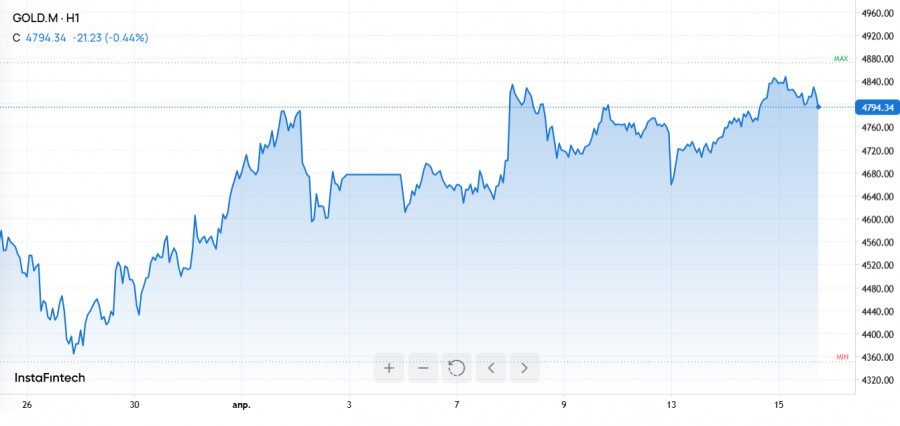
On Wednesday, gold was trading around $4,839 per ounce following a brief rise to a monthly high of $4,895; however, prices pulled back afterward. This was due to a new wave of interest in riskier assets and the anticipation of a possible resumption of peace talks between the U.S. and Iran.
UBS specifically notes that the dynamics since the start of the U.S.-Iran military operation on February 28 have been less favorable than expected: gold has failed to confidently break through resistance at $5,200. In contrast, the bank reminds us of last year's scenario, where the rise was 65%.
Although interest in hedging remains, UBS identifies rising oil prices as a limiting factor. High oil prices exacerbate inflation concerns and support the dollar, thereby reducing the appeal of gold as a non-yielding asset.
At the same time, the bank emphasizes that gold reacts not only to immediate combat events but primarily to broader economic consequences of the conflict—currency devaluation, budget deficits, and slowing growth.
The key rate is a focal point in UBS's projections, with the bank forecasting two 25-basis-point cuts by September. According to UBS logic, this will lead to a weakening of the dollar and a reduction in real yields, creating a "tailwind" for gold.
UBS's optimism coincides with actions from other major players. Private bank HSBC reported restructuring its portfolios, specifically reducing its holdings in Indian stocks and increasing investments in gold, cash, and hedge funds. The rationale for this decision includes risks associated with the war in Iran and high oil prices (according to Bloomberg).
Patrick Ho, HSBC Private Banking's Chief Investment Officer for North Asia, described India as the "most vulnerable" emerging market in Asia due to its sensitivity to energy costs.
Earlier, HSBC's research department expected gold to rise to $5,000 per ounce in the first half of 2026, based on geopolitical risks and concerns about government debt. However, the bank warned of a likely correction in the second half of the year if tensions begin to ease.
The market's tone continues to be set by the fragile interactions surrounding the U.S. and Iran. Following the disruption of peace talks on April 12, the dollar strengthened, and oil rose above $100 per barrel—amid preparations by the U.S. Navy for a possible blockade of the Strait of Hormuz. On that same day, the spot price of gold fell to about $4,717 per ounce—its lowest since April 7. The drop in response to news about diplomacy confirmed the high speed of traders' reactions to changes in the news backdrop.
Giovanni Staunovo noted that ongoing tensions surrounding Iran and the risks in the Strait of Hormuz are putting upward pressure on prices and increasing volatility in commodity markets, particularly the oil market. Even subsequent resolutions, according to UBS, will not eliminate the fundamental reasons for gold's rise.
For traders in the coming weeks, the main factors are expected to include: the dynamics of the dollar and real yields (in anticipation of the Fed's decisions), the behavior of the oil market (as an indicator of inflation risks), and the pace of changes in the geopolitical agenda surrounding Iran and the Strait of Hormuz. Under these conditions, UBS's range ($5,900–$6,200 by the end of 2026) remains a key benchmark for gold trading strategies.
RÁPIDOS ENLACES














 Contáctenos