The EUR/USD currency pair traded very calmly on Tuesday, despite the influx of news. We have long since stopped paying attention to macroeconomic data, as they do not provoke any market reaction. On Tuesday, only secondary reports were published, which had virtually no impact on the EUR/USD pair. Consequently, all market attention has once again turned to geopolitics.
It should be acknowledged that the market has been reacting much more calmly to geopolitical events lately than it did a few weeks ago. It is worth noting that negotiations between the US and Iran did not take place over the weekend, and the Strait of Hormuz remained closed for the entire weekend. In fact, Tehran refused to participate in the second round of negotiations until Washington lifts its blockade of the Strait of Hormuz. However, on Tuesday, it was announced that the second round of negotiations will indeed take place. When this will happen is unknown, but it's better to have some hope for peace than to face renewed war.
In principle, the market did not respond positively to the news that the negotiations would take place in Islamabad, and US Vice President JD Vance has already flown out for them. In our view, this is not surprising, as the geopolitical backdrop shifts practically every day. If the market reacted to every message, prices would fluctuate wildly. Therefore, the market has chosen a different strategy. It now reacts only to confirmed information that holds some significance. Did the negotiations fail? Great, but the situation in the Middle East has not worsened enough to discount this event. Will the negotiations still take place? Great, but the parties have not agreed on anything for which to celebrate.
As a result, many traders have adopted a simple position—waiting. We believe that the US and Iran will not reach an agreement on nuclear fuel, but at least they may agree to continue negotiating. Recall that the deadline for the two-week ceasefire expires today, so there are real chances for the war to resume. However, no one wants a war: neither Trump nor Iran. Neither side wants to concede, but neither wants to fight. Especially Trump, for whom a prolonged war in the Middle East equates to defeat.
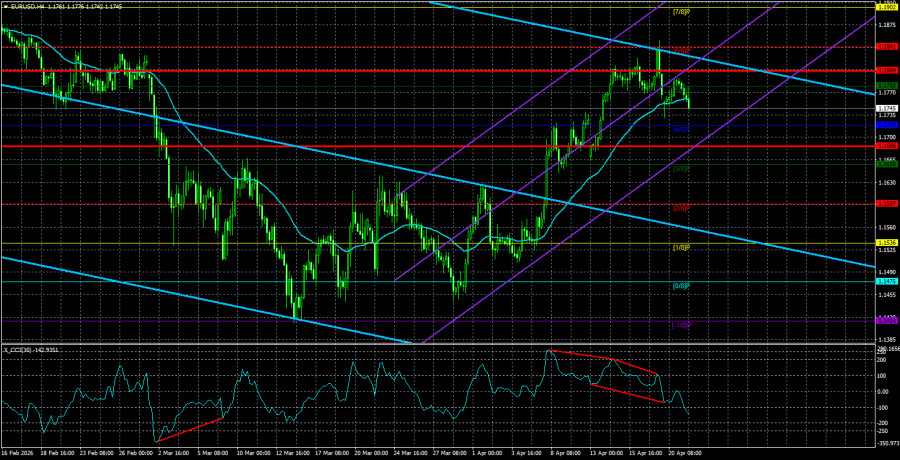
Thus, as we anticipated, the European currency is currently undergoing a correction after two weeks of growth. This is purely a technical correction in anticipation of consequential news. Therefore, a downward correction is possible this week. Regarding the longer-term outlook for EUR/USD, we see no reason to expect a decline. Even the geopolitical factor no longer supports the dollar as it used to. And if we set aside geopolitics, the US dollar has no advantages left. Consequently, whether or not negotiations continue and whether or not the war continues, we only expect a decline in the US dollar.
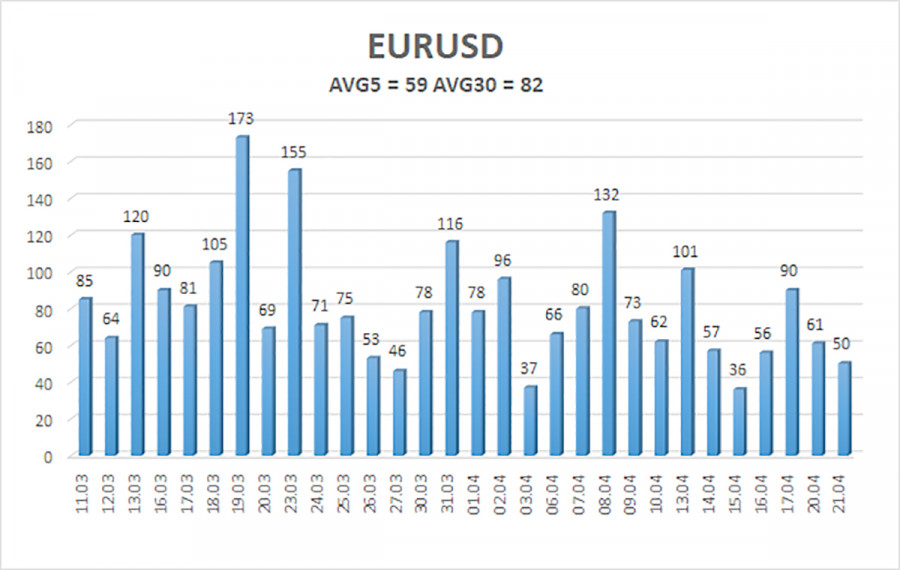
The average volatility of the EUR/USD currency pair over the last 5 trading days as of April 22 is 59 pips, which is considered "average." We expect the pair to trade between 1.1686 and 1.1804 on Wednesday. The upper linear regression channel has turned downward, signaling a bearish trend. However, in reality, the upward trend of 2025 may resume. The CCI indicator has entered overbought territory and has formed a "bearish" divergence, warning of a downward pullback.
The EUR/USD pair continues its upward movement amid a declining influence of geopolitics on market sentiment. The global fundamental backdrop for the dollar remains extremely negative, so in the long term, we still expect the pair to rise. If the price is below the moving average, short positions can be considered, with targets at 1.1686 and 1.1658 on technical grounds. Long positions are relevant when the price is above the moving average, with targets at 1.1841 and 1.1902. The market is gradually moving away from the geopolitical factor, and the dollar is losing its only growth driver.
Linear regression channels help to define the current trend. If both are directed in the same way, it means the trend is currently strong;
The moving average line (settings 20,0, smoothed) determines the short-term trend and the direction in which trading should currently be conducted;
Murray levels are target levels for movements and corrections;
Volatility levels (red lines) indicate the probable price channel in which the pair will operate over the next day, based on current volatility readings;
The CCI indicator – its entrance into the oversold area (below -250) or the overbought area (above +250) indicates that a trend reversal in the opposite direction may be approaching.
RÁPIDOS ENLACES



















 Contáctenos