Trade Review and Tips for Trading the Euro
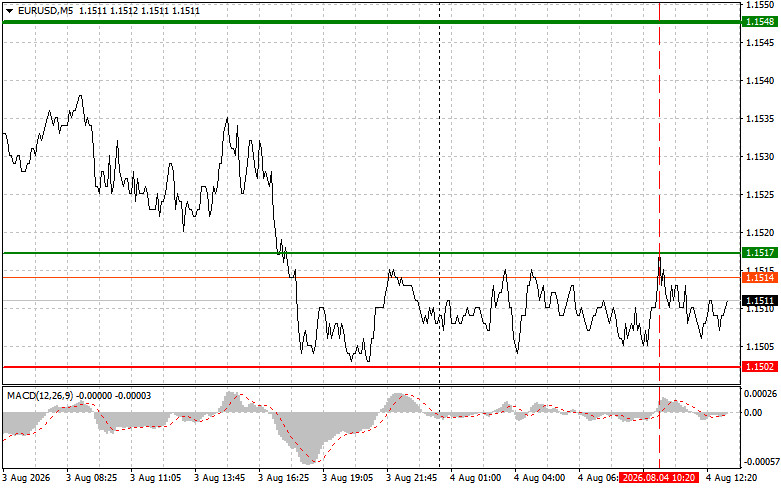
The first test of the 1.1517 level occurred when the MACD indicator had already moved well above the zero line, limiting the pair's upward potential.
The euro weathered the release of the secondary European economic data without losses, as expected, since the reports had little impact on the single currency. Far more important will be the upcoming batch of U.S. data, including the trade balance, the Job Openings and Labor Turnover Survey (JOLTS), and factory orders.
The trade balance reflects the difference between the value of exported and imported goods and services. A further deterioration could signal declining competitiveness among U.S. producers in international markets. The Bureau of Labor Statistics' reports on job openings and labor turnover serve as a key barometer of labor market conditions. A high number of job openings combined with low employee turnover indicates strong demand for labor and confidence among workers, which could support the U.S. dollar. Factory orders, in turn, reflect activity in the manufacturing sector, one of the pillars of the economy. An increase in factory orders points to stronger business activity.
The implications for the euro are straightforward. Strong U.S. labor market data could strengthen the dollar and put pressure on the EUR/USD pair, while disappointing figures would support the euro.
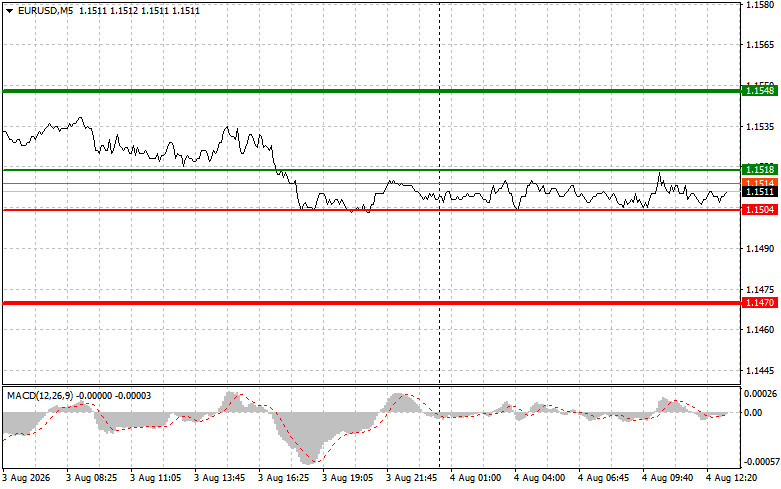
As for my intraday strategy, I will primarily rely on the implementation of Scenario #1 and Scenario #2.
Scenario #1: Today, consider buying the euro if the price reaches the 1.1518 level (green line on the chart), targeting a move to 1.1548. At 1.1548, I plan to exit long positions and open short positions, expecting a 30–35 point pullback from the entry point. The euro is likely to strengthen today if the U.S. data come in weaker than expected.
Important: Before opening a long position, make sure the MACD indicator is above the zero line and is just beginning to move higher.
Scenario #2: I also plan to buy the euro if the 1.1504 level is tested twice consecutively while the MACD indicator is in oversold territory. This would limit the pair's downward potential and trigger a bullish reversal. In this case, a rise toward 1.1518 and 1.1548 can be expected.
Scenario #1: I plan to sell the euro after the price reaches 1.1504 (red line on the chart), targeting a decline to 1.1470. At 1.1470, I intend to close short positions and immediately open long positions, expecting a 20–25 point rebound. Downward pressure on the pair is likely to return if the U.S. data come in stronger than expected.
Important: Before opening a short position, make sure the MACD indicator is below the zero line and is just beginning to move lower.
Scenario #2: I also plan to sell the euro if the 1.1518 level is tested twice consecutively while the MACD indicator is in overbought territory. This would limit the pair's upward potential and trigger a bearish reversal. In this case, a decline toward 1.1504 and 1.1470 can be expected.
Important: Beginner Forex traders should exercise great caution when making trading decisions. It is generally advisable to stay out of the market ahead of major fundamental releases to avoid sharp price swings. If you choose to trade during news releases, always use stop-loss orders to minimize potential losses. Trading without stop-loss orders can quickly result in the loss of your entire deposit, especially if you trade large position sizes without proper risk management.
Finally, remember that successful trading requires a clear trading plan, such as the one outlined above. Making spontaneous trading decisions based solely on current market conditions is generally a losing strategy for an intraday trader.
RÁPIDOS ENLACES



















 Contáctenos