Revisiones analíticas

Las revisiones analíticas de Forexmart proporcionan información técnica actualizada sobre el mercado financiero, que van desde tendencias bursátiles hasta proyecciones financieras, informes de economía mundial y noticias políticas que afectan al mercadoLeer más

Disclaimer:  ForexMart no ofrece asesoría de inversión y el análisis proporcionado no debe interpretarse como una promesa de resultados futuros.

How to Trade the EUR/USD Currency Pair on September 17? Simple Tips and Trade Review for Beginners
02:39 2026-09-17 UTC+00

Trade review for Wednesday:

1H chart of the EUR/USD pair

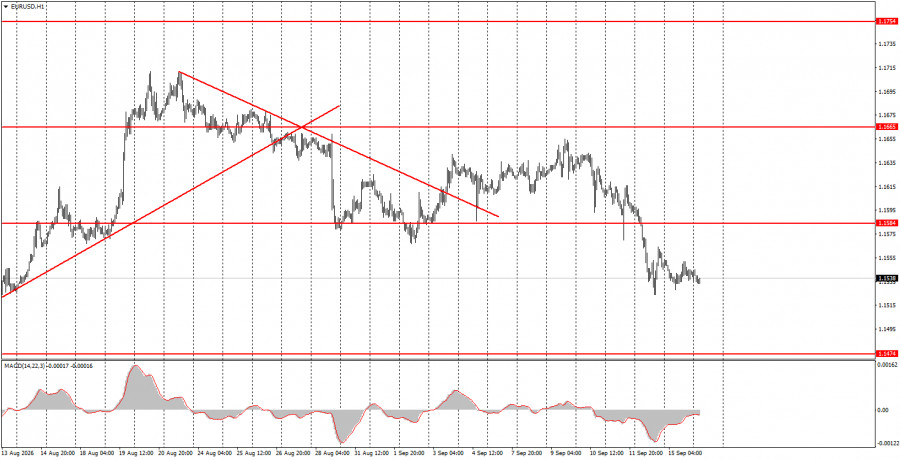
The EUR/USD currency pair plunged like a stone on Wednesday evening. Traders expected Federal Reserve tightening, but no one could have guessed the US central bank would take such a hawkish stance. In effect, the Fed not only raised the policy rate but signaled at least one more tightening before year-end, and most FOMC members fully backed the new chair. Thus, the Fed hiked not as a formality and not to please markets — it has truly committed to fighting high inflation and is ready to keep tightening until inflation returns to 2%. That hawkish stance allowed the dollar to continue strengthening even though it had already risen during the prior five days on tightening expectations. In short: the dollar rose first on expectations and then on the facts. As we warned earlier, the market may simply have been looking for any excuse to buy the US currency — and it found that excuse on Wednesday evening.
5M chart of the EUR/USD pair

analytics6aab5267c2cd4.jpg

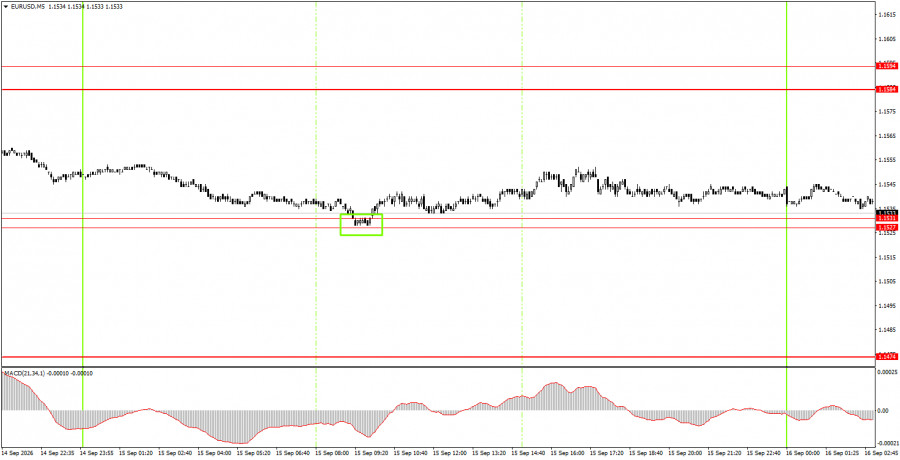
On the 5-minute timeframe on Wednesday, two trading signals were formed. The first buy signal did not push the euro higher, and it made little sense to take a long ahead of the Fed announcement. The sell signal formed on a close below the 1.1527–1.1531 area, and traders could have profitably traded a short position. Given the Fed's stance, that was a sensible move.

How to trade on Thursday:

On the hourly timeframe, the EUR/USD pair continues a downward move that may now evolve into a full-blown trend. Given recent months' events, we don't think the euro should collapse like a stone — but the market's primary focus is Fed policy, which this week became materially more supportive of the US dollar.

On Thursday, novice traders may open short positions targeting 1.1366–1.1377 if price consolidates below 1.1461–1.1474. Longs can be opened targeting 1.1527–1.1531 in case of a bounce from the 1.1461–1.1474 area.

On the 5-minute timeframe, consider the levels 1.1267–1.1275, 1.1366–1.1377, 1.1461–1.1474, 1.1527–1.1531, 1.1584–1.1594, 1.1655–1.1665, 1.1745–1.1754. On Thursday, the euro area will publish only the final August inflation print, and the US will release several secondary reports. We do not expect any significant market reaction to those releases.

Key Rules of the Trading System:

  1. The strength of a signal is determined by the time it takes to form the signal (rebound or breakout). The less time taken, the stronger the signal.
  2. If two or more trades were opened at a certain level based on false signals, all subsequent signals from that level should be ignored.
  3. In a range (flat), any pair can generate many false signals or may not produce any at all. Technical levels may be disregarded.
  4. On the hourly timeframe, trading signals from the MACD indicator should be acted upon only when volatility is high, and a trend line or trend channel confirms the trend.
  5. If two levels are too close together (within 5-20 pips), treat them as a support or resistance area.
  6. After moving 15 pips in the right direction, a stop-loss should be set to break even.

What to Look for on the Charts:

Price levels (areas) of support and resistance serve as targets for opening buy or sell trades or as sources of signals.

Red lines indicate channels or trend lines that show the current trend and the preferred trading direction.

The MACD indicator (14,22,3) — the histogram and signal line — is an auxiliary indicator that can also provide signals.

Important speeches and reports (listed in the news calendar) can significantly influence currency pair movements. Therefore, during their release, traders should approach trading with utmost caution, or exit the market to avoid sudden reversals against the preceding move.

Beginner forex traders should remember that not every trade can be profitable. Developing a clear strategy and practicing money management are key to long-term success in trading.
Comentario

ForexMart is authorized and regulated in various jurisdictions.

(Reg No.23071, IBC 2015) with a registered office at First Floor, SVG Teachers Co-operative Credit Union Limited Uptown Building, Corner of James and Middle Street, Kingstown, Saint Vincent and the Grenadines

Restricted Regions: the United States of America, North Korea, Sudan, Syria and some other regions.


aWS
© 2015-2026 Tradomart SV Ltd.
Top Top
Advertencia de Riesgo:
El mercado de divisas es altamente especulativo y complejo por naturaleza, y puede no ser adecuado para todos los inversores. Las operaciones en Forex pueden resultar en ganancias o pérdidas sustanciales. Por lo tanto, no es aconsejable invertir dinero que no puede permitirse perder. Antes de utilizar los servicios ofrecidos por ForexMart, reconozca los riesgos asociados con las operaciones en Forex. Busque asesoramiento financiero independiente si es necesario. Tenga en cuenta que ni el rendimiento pasado ni los pronósticos son indicadores confiables de resultados futuros.