The US president continues to surprise with constant shifts in his rhetoric on nearly every topic, except the Fed. When it comes to the Fed, the message is simple: the central bank should be cutting rates all the time and ideally push them into negative territory so the US economy grows at the pace Donald Trump wants. That way he can point to the latest GDP figures and claim he delivered on his promise: "the era of prosperity" has begun. What inflation will be in that scenario? The president doesn't seem to care. Why would he? Inflation hits ordinary people's wallets first — everyday Americans and farmers with wage earners. Who cares how they live?
Last year, in the name of fiscal health, Trump cut several social and healthcare programs. Many Americans accepted that as necessary because the US public debt then stood at $37 trillion. In addition, Trump started a war with Iran in 2026, and the world saw where the money went — to war. Public debt has now climbed to $40 trillion because US Treasuries are in low demand and investors demand a large risk premium for future inflation, which Trump treats as perfectly normal.
The result is stark: ordinary Americans don't get state support, while money is funneled into war. On top of that, Trump effectively taxed every American through import tariffs that the US Supreme Court later ruled unlawful. By 2026, each American is paying one-and-a-half to two times more for fuel — price increases driven in part by Trump's policies.
Yet the confrontation with Iran has put the president in a clear bind. Tehran hasn't caved — it tossed Washington's ultimatums aside — and even the world's most powerful military has shown it can't force a resolution. The president's approval ratings collapsed months ago to historic lows for a two-term president and continue to set new negative records each month. Trump needs to end the war quickly if the Republican Party is to have any chance in the upcoming elections. But how can he do that when Iran clearly understands the trajectory of events and refuses to make concessions?
Over the weekend, the White House leader said he would soon make a major decision on Iran: economic pressure, renewed military action, or a ceasefire. Frankly, which of these options looks least far-fetched? Economic pressure on Iran is unlikely to be effective and is not a palatable option for anyone except Trump himself. Renewed military action would be pointless. A ceasefire — under what terms and on whose conditions? Would Trump really abandon his ambition to force Iran to give up nuclear ambitions? In short, the president can announce a decision, but it is unlikely to be a straightforward ceasefire. Maybe he wants peace, but achieving it now would be extremely difficult. We cannot even theorize a clear pathway to ending the conflict in the Middle East.
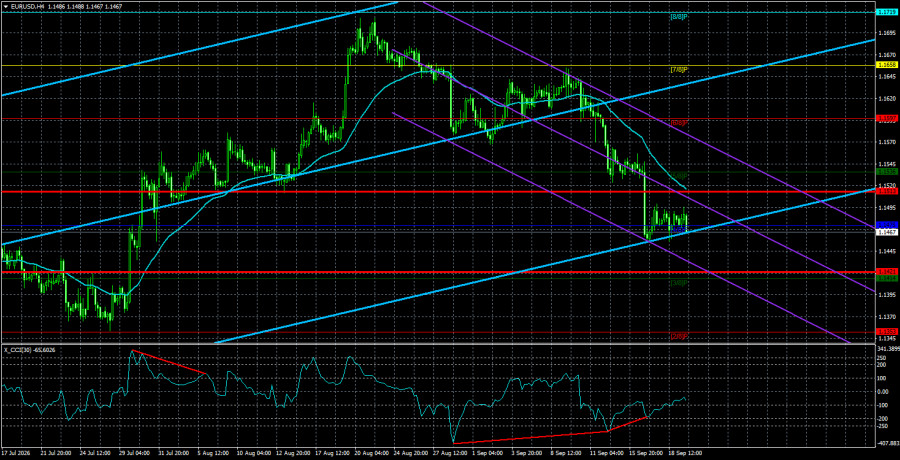
EUR/USD continues to move in a downtrend, but we still view the pair's decline as a correction ahead of a new uptrend. The global fundamental backdrop for the dollar remains negative, but in 2026, geopolitics first and then the Fed's hawkish stance provided strong support for the US currency. With the price below the moving average, short positions can be considered with targets at 1.1421 and 1.1414. If the price is above the moving average, long positions are relevant with targets at 1.1597 and 1.1658.
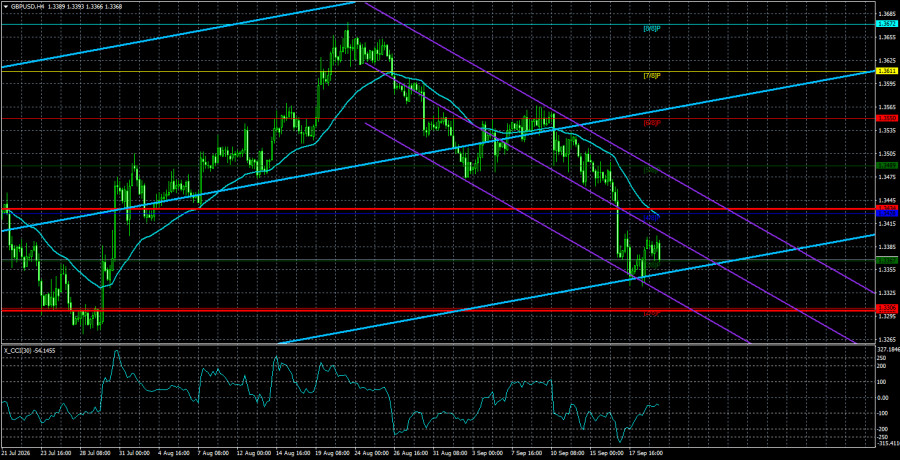
GBP/USD retains an upward trend. Donald Trump's policies will continue to put pressure on the US economy, so we do not expect long-term dollar strength. 2026 has so far been positive for the dollar due to geopolitics and inflation, which drove capital toward safe havens and pushed the Fed back toward policy tightening. However, on the weekly chart, the pair remains in a flat range between 1.3150 and 1.3780 within a four-year uptrend, which supports the case for further pound gains in the medium term. Long positions with targets at 1.3489 and 1.3550 can be considered when the price is above the moving average. If the price sits below the moving average, consider short trades with targets at 1.3306 and 1.3302.
RÁPIDOS ENLACES



















 Contáctenos