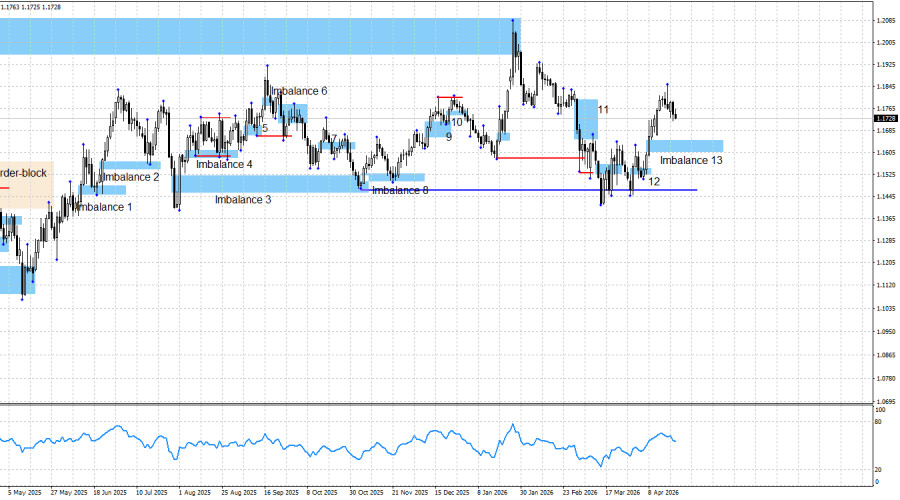
The EUR/USD pair continues to trade within a mild corrective pullback this week. I cannot say that this week's news supports the bears, but at the same time the geopolitical factor is once again tilting in favor of the U.S. dollar. Over the past five days, the market has received a dozen reports suggesting that negotiations between Iran and the U.S. would take place "tomorrow," all of which were denied by Tehran. The entire news flow now boils down to alternating statements: "talks will take place" and "no, they won't." Since Iran continues to firmly refuse meeting with the U.S. delegation, the market is once again leaning toward a possible resumption of war in the Middle East. I do not believe that a renewed conflict would provide enough support for bears to push EUR/USD below the last low around 1.1400, but the euro could decline toward imbalance 13.
The bullish advance began after a reaction to bullish imbalance 12. This gave traders an opportunity to open long positions, which are currently in solid profit. Now traders can decide whether to lock in profits or wait for further growth. The geopolitical backdrop is currently better than it was a few weeks ago, which likely explains the sharp improvement in bullish sentiment. However, sentiment could quickly shift in favor of bears if the Middle East conflict resumes. From a technical standpoint, no bearish signals or patterns have formed, so I do not expect a sharp decline in the euro.
It is also worth noting that the entire rise of the U.S. dollar over the past 1.5–2 months was driven solely by geopolitics. As soon as the U.S. and Iran agreed to a two-week ceasefire, bears immediately retreated and bulls rushed back into the market. At present, the truce remains fragile but is still holding, despite failed talks last Saturday and cancellations on Monday, Tuesday, and Wednesday. I have repeatedly stated that I do not believe the bullish trend has ended, despite the break of key structural lows. The price action of the past two months could turn into a bearish trend only if the geopolitical situation deteriorates further. However, markets often price in the worst-case scenario in advance, trying to anticipate the most extreme outcomes. Therefore, it is possible that traders have already fully priced in the Middle East conflict.
The technical picture is currently clear. First, the price showed no reaction to imbalance 11. Second, it reacted to imbalance 12, forming a bullish signal within a bullish trend. Third, a new bullish imbalance 13 has formed, which represents both a potential buying zone and a support area for the euro.
The news background on Wednesday was practically nonexistent. The only update was that no meeting between Iran and the U.S. would take place that day. No one knows when it will happen. It is also unclear how long Donald Trump is willing to wait or whether he is ready to resume military action in the Middle East.
There are still plenty of reasons for bulls to remain active in 2026, and even the outbreak of conflict in the Middle East has not reduced them. Structurally and globally, Trump's policies—which led to a significant decline in the dollar last year—have not changed. In the near term, the U.S. dollar may occasionally strengthen due to risk aversion, but this requires constant escalation in the Middle East, which is unlikely. A two-week pause was enough for the euro to recover by 60%. There are no other strong supportive factors for the U.S. dollar. I still do not believe in a sustained bearish trend for the euro. The dollar has received temporary support, but what will drive bears in the long term?
Economic calendar for the U.S. and the Eurozone:
On April 23, the economic calendar includes seven entries, with Eurozone PMIs drawing the most attention. However, the overall impact of the news flow on market sentiment on Thursday is likely to remain weak.
EUR/USD forecast and trading advice:
In my view, the pair is still in the process of forming a bullish trend. The information backup shifted sharply two months ago, but the trend itself cannot yet be considered cancelled or completed. Therefore, bulls may continue their advance in the near term unless geopolitics sharply turns toward renewed escalation.
Traders had an opportunity to open long positions based on the signal from imbalance 12, and the upward move may continue toward this year's highs. A new imbalance 13 has also formed, which could provide another bullish signal in the future. For uninterrupted growth of the euro, the Middle East conflict would need to move toward a stable peace—which is not currently the case. However, bears are not gaining additional reasons to attack either. For now, I would rely primarily on technical analysis.
HIZLI BAĞLANTILAR
show error
Unable to load the requested language file: language/turkish/cookies_lang.php
date: 2026-04-22 10:21:48 IP: 172.18.0.1














 Bize Ulaşın