The EUR/USD pair posted a small gain on Wednesday, though most traders likely did not expect it. The key point is that the results of the Federal Reserve's penultimate meeting
The EUR/USD pair posted a small gain on Wednesday, though most traders likely did not expect it. The key point is that the results of the Federal Reserve's penultimate meeting had been released the previous evening. The market had effectively already decided the fate of the policy rate for the coming months before the meeting. In essence, it became clear a month ago that the Fed would hold in October and raise again in December. Over the past month, the market actively bought the dollar, and the U.S. currency had been rising even in recent days. That suggested most hawkish scenarios had long since been priced in. Kevin Warsh offered nothing new or market-moving. He reiterated elevated inflation but did not signal a concrete likelihood of another March hike next year—though the market had already largely priced that in anyway. In short, we saw nothing decisive last night: no new dollar rally or dollar sell-off. Traders are therefore once again left to rely mainly on technicals. Today the European Central Bank meets, but expectations for any logical, consistent market reaction are limited here, too.
Technically, the downtrend could be considered complete because the trend line was broken. However, the market still appears prepared to keep offloading euros for another couple of months in favor of dollars. Price sits below the Ichimoku lines, so the trend can still be treated as downward for now.
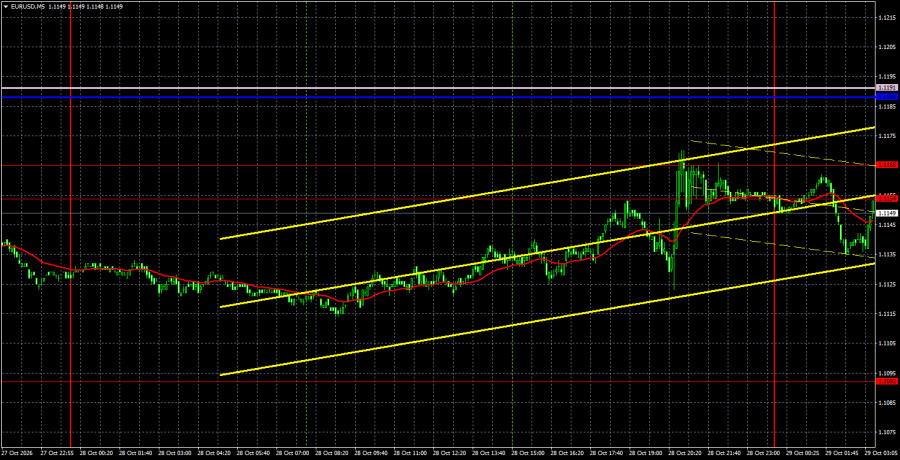
On the 5-minute timeframe, no trade signals formed on Wednesday. Only toward the end of the day did price work the 1.1154–1.1165 area and bounce from it twice. In any case, opening positions during the Fed release was probably unwise — the market's reaction was weak, and we saw no clear grounds to open new short positions.
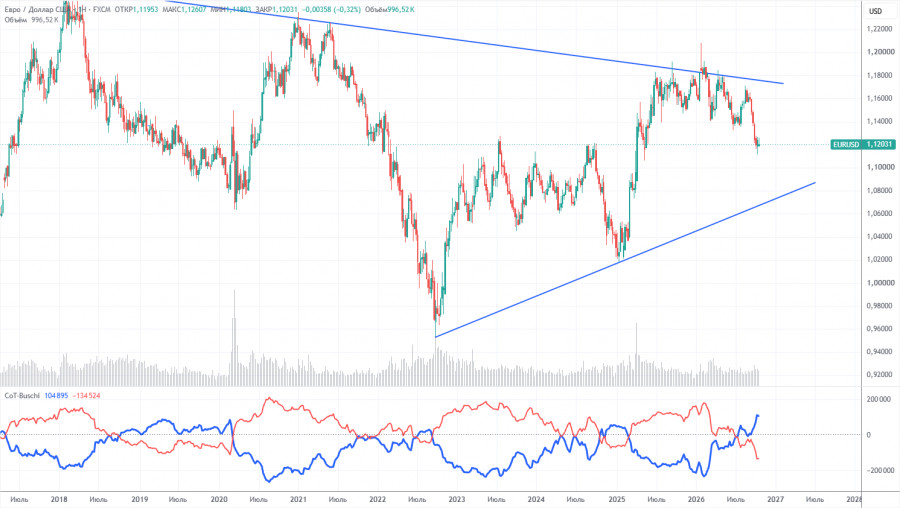
The latest COT report is dated October 20. On the weekly TF, non-commercial traders' net position remains clearly bearish and has declined significantly in 2026 due to geopolitical events. Over the past eight months, traders have been exiting the euro in favor of the U.S. dollar. Donald Trump's policies have not changed, but the dollar served as a reserve currency for a time.
However, we still do not see any fundamental factors that would further strengthen the U.S. dollar. The war in the Middle East made the dollar super-attractive for a while, and the Fed's monetary-policy stance surprised the dollar for the second time this year. In the long term, the euro could fall as low as $1.08 (the trend line), but the longer-term uptrend will remain relevant. Nevertheless, in recent weeks the market has priced in only positive factors for the dollar and ignored everything else.
The arrangement of the red and blue indicator lines points to the bears' advantage. During the last reporting week, long positions among the "Non-commercial" group rose by 3,500, while short positions increased by 500. Accordingly, the net position rose by 3,000 contracts over the week.
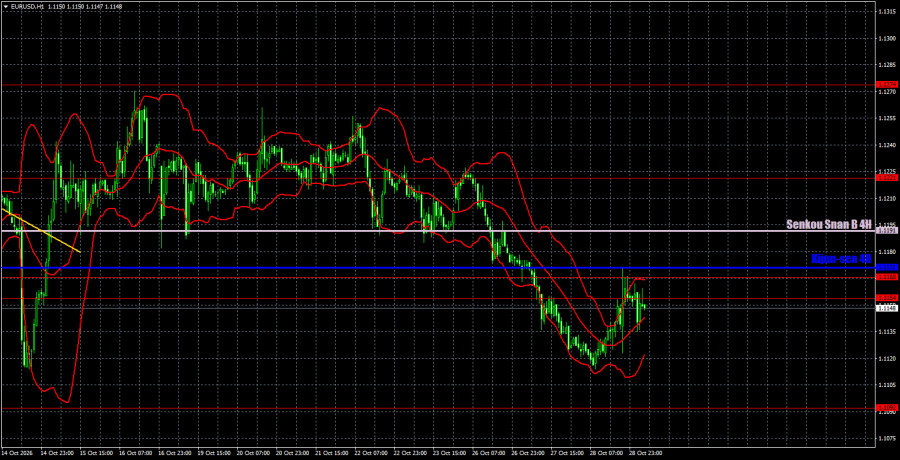
On the hourly timeframe, the EUR/USD pair finally has the opportunity to form an uptrend. On the daily and weekly timeframes, the chances of a strong, lasting trend remain high. However, for the euro to rise, buyers must step in. Over the past two weeks and two months, the market has shown no willingness to buy the euro. Therefore, based on market sentiment, we think a new decline is more likely, regardless of macroeconomics and fundamentals. Traders can now rely primarily on technicals when making trading decisions.
For October 29 we highlight the following levels for trading — 1.1092, 1.1154–1.1165, 1.1221, 1.1274, 1.1362–1.1368, 1.1461–1.1473, 1.1536–1.1542, 1.1585, 1.1657–1.1665, as well as the Senkou Span B line (1.1191) and the Kijun-sen (1.1171). Ichimoku lines may shift during the day, so account for this when determining trading signals. Remember to move your Stop Loss to breakeven after the price moves 15 pips in the right direction — this will protect against losses if the signal proves false.
On Thursday, the ECB will hold its meeting, and Christine Lagarde will speak in the euro area, while the U.S. will publish important Q3 GDP and September PCE reports. Thus, higher volatility can be expected today, but U.S. data are likely to attract more interest than the ECB meeting.
Traders can consider targets for shorts near 1.1092 if price bounces today from the 1.1154–1.1165 area. If price holds above the Senkou Span B line, consider long positions at 1.1221 and 1.1274.

HIZLI BAĞLANTILAR
show error
Unable to load the requested language file: language/turkish/cookies_lang.php
date: 2026-10-29 10:18:43 IP: 172.18.0.1








 Bize Ulaşın