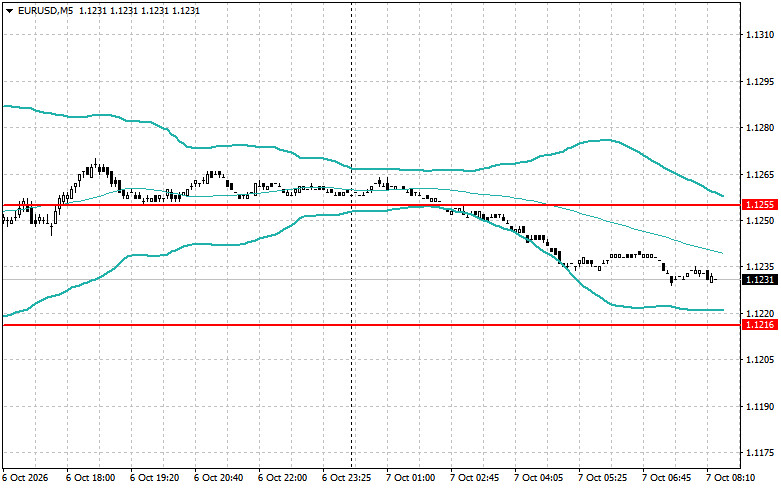
Yesterday evening, the euro and pound both benefited from weak US data, and the yen also rallied afterward. In the Asian morning, the picture changed: demand for the US currency returned, and part of yesterday's move came under question. Comparing the evening with the morning, you see a familiar pattern. Any weak US print gives the currencies a short breather, but once the market catches its breath, participants again move to the safe-haven asset.
Support for the euro now mainly rests on yesterday's developments. The bounce from the 17-month low the pair hit early in the week is held more by calm in French bonds than by economic strength. The spread between French and German yields remains the widest since 2011, and while it stays so, any good regional news will have only half the effect.
The pound also had yesterday's support. The construction PMI rose to 46.1, so the sector's contraction slowed, and the currency rose in response. But the 50 mark is still far away, meaning construction continues to contract, and it's too early to celebrate. Bank of England rate expectations support the pound, while budgetary uncertainty ahead of the autumn budget prevents stronger gains.
As I noted above, the dollar fell yesterday on US trade data for August. The trade deficit — the gap between how much the country buys abroad and how much it sells — rose to $105.6bn, the largest since early 2025. Imports hit a record, up 4.3%, while exports rose only 1.4%. A significant share of the increase came from investment goods, i.e., firms actively buying equipment. The signal is two-sided. Strong imports indicate real demand, but for GDP accounting they subtract from growth, and the Atlanta Federal Reserve now expects net exports to shave some growth in Q3. GDP grew only 1.5% annualized in Q2. For the dollar, this is uncomfortable but not fatal, since weak trade does not erase its role as a safe haven.
Today the euro has no local catalysts for a rally. In the first half of the day, German industrial production for August and France's trade balance for the same month will be released. Forecasts are mediocre. Germany is expected to show roughly +0.5% after July's drop, which itself was revised to -1.6% from an initial -1.1%. A bounce out of a deep hole looks more like a technical correction than a recovery, since the largest economy's industry remains weak. In France, they watch the trade deficit: July's was €6.7bn, and August is expected to narrow slightly to €6.5bn. An improvement of €0.2bn solves nothing because France's external trade has long been weak, and recent budget and political worries pushed the euro to a May-2025 low. While French yields trade with a wide spread to German bunds, a weak balance only reinforces investor distrust. If the gap between expectations and actual data persists, the market will return to a skeptical view of the region's economy.
For the pound, the calendar is almost empty today. In the first half of the day only Lloyds' house-price index for September will be released, with a small rebound expected after August's decline. This second-tier indicator adds a brushstroke to consumption, but it is unlikely to kick off a new recovery wave.
The main event of the evening will be the minutes of the September Fed meeting. I believe that until the minutes are released, both pairs will remain dependent on dollar moves and news from Paris, and any reaction to weak data will likely be a short retracement rather than an independent trend.
The distances between levels are small today, so precision matters more than speed.
For the euro — above 1.1241 I see a path to 1.1275 and then 1.1310. That move would require German industry not to disappoint and Paris to remain calm, and my conviction is moderate because the dollar reclaimed some demand this morning. Below 1.1202 targets 1.1165 and 1.1133 open. That downside scenario fits better with a return of dollar demand and weak regional data, so my priority is to sell — but only if price closes below 1.1202. The range between the points is 39 pips, and the pair can easily traverse it back and forth before European data, so I would skip the first touches.
For the pound — long positions are considered above 1.3254 with targets 1.3279 and 1.3307, and short positions below 1.3228 with targets 1.3202 and 1.3181. The distance between points is only 26 pips, a very tight range, and with a quiet UK calendar, the pound will be driven by the dollar. The bullish scenario relies on yesterday's construction PMI but runs into the budget story, so I would be cautious about expecting a move beyond 1.3279. The bearish scenario looks more likely if the US currency continues to gain after the Asian session. The Fed minutes tonight can flip the balance either way.
Today the reference levels sit right next to breakout points, and that is where mistakes are easiest.
For the euro, the upper reference 1.1255 is 14 pips above the breakout point 1.1241 and lies on the way to the first target 1.1275. If price breaks 1.1241 and holds above, then 1.1255 is just a stopover and selling there is forbidden. If price spikes above 1.1255, fails to hold, and returns below 1.1241, I consider selling with a stop above the failed-attempt high. The lower reference 1.1216 sits inside the range, 14 pips above the breakout 1.1202 and 25 pips below 1.1241. A poke below 1.1216 followed by a quick return above gives a buy idea, but I treat it as a short-term play — not a reversal — and place the stop under the poke low. If price calmly reaches 1.1202 and consolidates below, the return idea is canceled, and the downside breakout is in play. A retracement is more likely if German figures print near forecasts, because then the initial reaction will quickly fade.
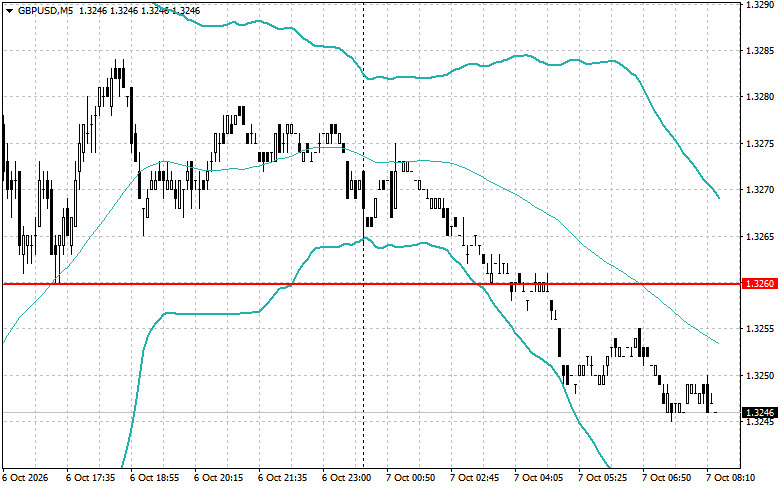
For the pound, the upper reference 1.3260 sits only 6 pips above the breakout 1.3254, so novices must be especially cautious. Such a gap is smaller than normal market noise, so you cannot distinguish a real breakout from a false one on the first touch. If price passes and holds above that zone, the move to 1.3279 is underway, and selling is forbidden. If price spikes above 1.3260, fails to hold and falls back below 1.3254, the mean-reversion sell works with a stop above the local high. The lower reference 1.3234 is also close — 6 pips above the breakout 1.3228, inside the range. If price dips below 1.3228 and consolidates, that is a downside breakout and buying is forbidden. If price pokes under 1.3234 but does not reach 1.3228 and quickly returns above 1.3234, then longs are possible with a stop under the poke low. For the pound, this setup is particularly appropriate with a quiet UK calendar, since the pair will hover around dollar moves and the market often retraces the first reaction to any news.
RYCHLÉ ODKAZY




















 Kontaktujte nás