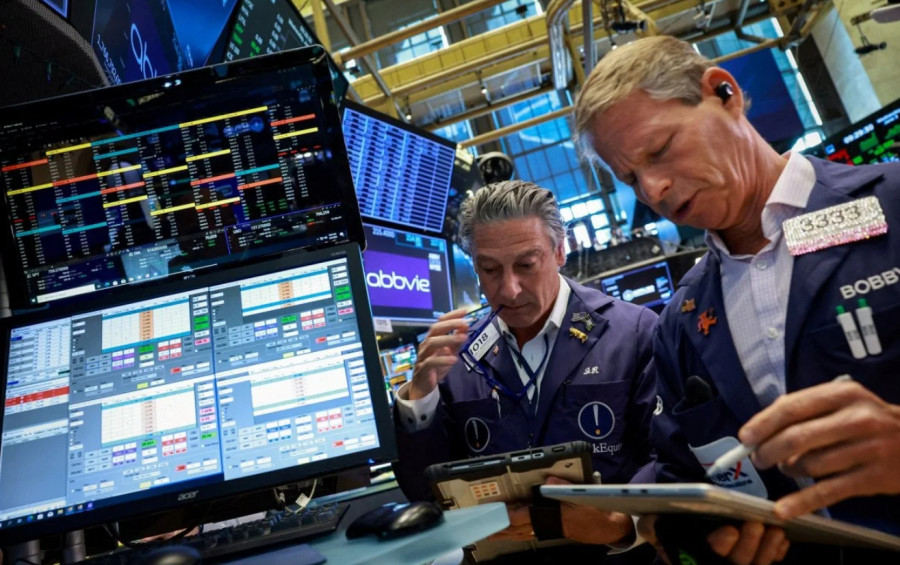
Wall Street closed out a losing week: on Friday, US benchmark stock indices fell again as investors digested renewed swings in semiconductor stocks and a wave of quarterly reports that call into question the strength of the recent AI?fuelled rally.
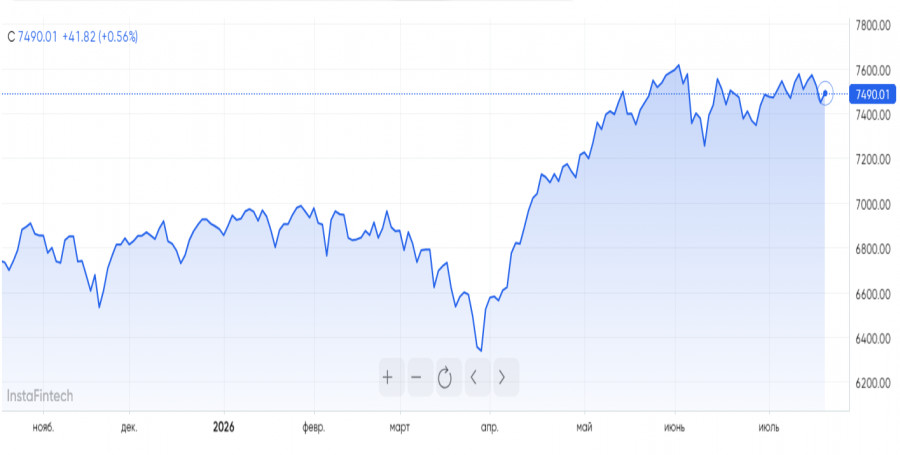
On Friday, the S&P 500 fell 1.01% to close at 7,457.69, while the Nasdaq Composite dropped 1.4% to 25,520 — tech stocks bore the brunt of the decline. The Dow Jones Industrial Average lost 406.55 points, or 0.77%, finishing the session at 52,146.42.
Semiconductor makers, which until recently accounted for a large share of the market's gains, led the sell?off, and losses then spread to other sectors.
For the week, the losses were notable: the S&P 500 declined 1.6%, the Nasdaq fell 2.9%, and the Dow dropped 0.9%. The Philadelphia Semiconductor Index posted its worst weekly performance in more than a year and plunged more than 18% just in the past month.
At the start of the new week, US stock futures were slightly higher after the recent correction: investors are preparing for a busy earnings season that in the coming days will test the durability of optimism around AI. Market sentiment remains cautious amid rising tensions in the Middle East.
Q2 earnings season is gaining momentum: this week, corporate reports are expected from Alphabet, Tesla, Intel, and IBM, among other large companies. Investors are looking for answers to the key question — will the biggest cloud infrastructure providers continue to spend heavily on AI?
Those expenditures are the foundation of the current rally, supporting stocks of semiconductor makers and other companies tied to AI development, and helping push major indexes to record highs.
If the reports confirm that AI infrastructure buildout remains in an active investment phase, investors' patience may run out, which could extend the recent correction through the summer.
For now, the earnings season is still in its early stages: 49 S&P 500 companies have reported so far. Of those, 90% beat analysts' expectations, LSEG data show.
Analysts now forecast year-over-year S&P 500 earnings growth of 26.0%, well above the 19.2% estimate recorded on April 1, according to LSEG.
Yardeni: "The S&P 500 first reached 7,500 on May 14 and has since remained near that level. The index continues to trade along its 50-day moving average. A 6.0% decline would bring it back to the 200?day moving average. We've already seen this scenario — late 2024 to early 2025 and again late 2025 to early 2026. In both cases, there was similar sideways consolidation followed by corrections that attracted buyers on the drops. In our view, this is the likely scenario through September. We still look to 8,250 by the end of the year."
Morgan Stanley: "Our market-breadth thesis continues to play out as the index struggles to make new highs and previous leaders correct. This leadership shift is likely to persist and could lead to further consolidation in major indexes before the bull market resumes in full. We still prefer large cloud infrastructure providers over semiconductor makers for the next few months... At the same time, we acknowledge the risk/reward has become less attractive after nearly 30% relative outperformance in just three weeks."
Evercore ISI: "The post?pandemic environment has opened a new brave world. For investors, this new world does not mean the end of the US equity bull market. None of the signs of an 'endgame' are obvious: no recession, the Fed is not rushing to raise rates, long bond yields are stable, and there is no sign of unchecked euphoria. Volatility in tech stocks remained elevated throughout the furious 1990s rally, when corrections were the norm rather than the exception — particularly in the rapid second half of 1999, whose price action from the market low on March 30 to the summer of 2026 so closely resembles the current environment."
JPMorgan: "We advocate rotation and market breadth expansion in the second half of the year... while retaining medium?term concerns about monetizing the massive capex growth of the largest cloud providers and remaining fundamentally negative on Software, Business Services and Media — sectors at risk of displacement by AI... Nevertheless we do not expect prolonged market weakness amid these rotations. We believe various groups of AI companies should not fall much in absolute terms for long, given likely resilient profit growth and increasing support from valuations. In particular, semiconductor makers should find buyers soon."
RBC Capital Markets: "Our model estimates do not yet signal a clear reversal, although several of our charts indicate rotation is in an advanced stage. Considering the sideways dynamics in the relative performance of US vs. foreign markets, and the return of relative measures — growth/value, high/low price momentum, and the top?10 vs. the rest of the S&P 500 — to levels near past inflection points where they attempted to stabilize, we remain vigilant for a possible return to leadership by mega?cap growth stocks."
In the coming days, investors will closely monitor quarterly reports and management commentary from the largest companies — these will largely determine whether the summer correction continues or the market resumes advancing.
QUICK LINKS



















 Contact Us