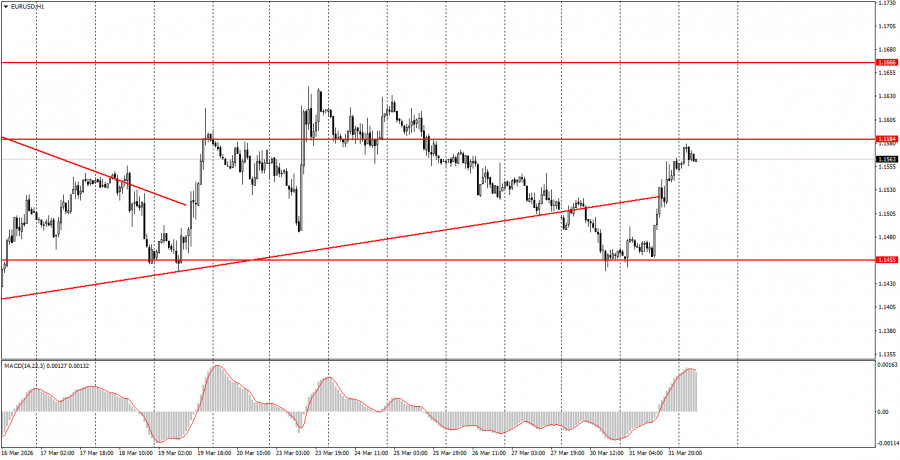
The EUR/USD currency pair finally showed a noticeable rise on Tuesday, triggered by several factors. First, Jerome Powell reassured the markets the day before that the Fed does not plan to tighten monetary policy in the near future. Second, the inflation reports from Germany and the Eurozone showed significant growth in March, bringing the possibility of the first ECB rate hike in a long time much closer. Third, Donald Trump again mentioned that the war in the Middle East could end very soon. Fourth, the JOLTs report on job openings in the US came in below expectations. Thus, for the first time in several weeks, the stars aligned so that the euro appreciated slightly. Overall, it is very encouraging that the market responded to macroeconomic data, suggesting that upcoming reports will also be taken seriously. Ahead are important US reports: the ISM Manufacturing Index, Non-Farm Payrolls, and the unemployment rate. If these reports disappoint, the dollar will continue to decline, at least in a corrective manner.
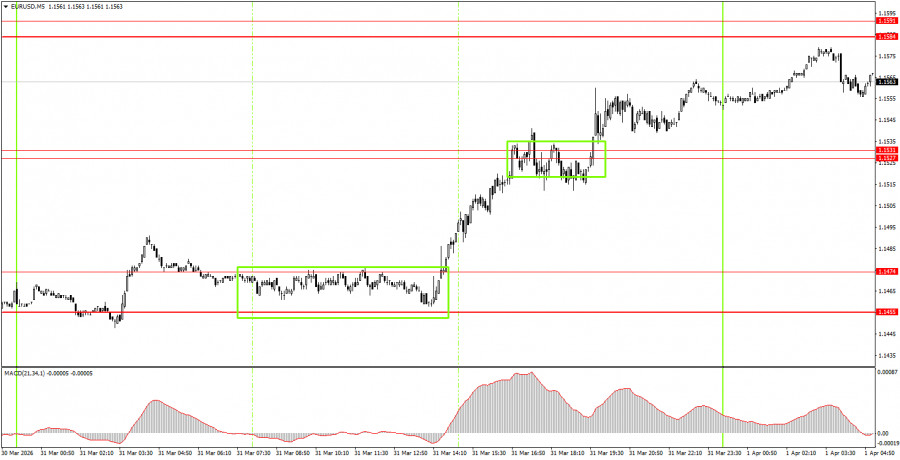
On the 5-minute timeframe on Tuesday, two trading signals were generated. During the European trading session, the price bounced off the area of 1.1455-1.1474, and in the American session, it broke through the area of 1.1527-1.1531. Consequently, novice traders could open one long position, which was in profit of about 60-70 pips by the end of the day.
On the hourly timeframe, the ascending trend line has been breached, and once again, we did not see a substantial upward trend. In early 2026, the long-term upward trend resumed, so we still expect continued long-term growth of the euro. The overall fundamental backdrop is very complicated for the US dollar; however, for the market, the main focus currently remains on geopolitics. It is this issue that has prevented the pair from resuming its upward global trend and has pulled it down for the past month and a half.
On Wednesday, novice traders may consider short positions if the price bounces off the 1.1584-1.1591 area, targeting 1.1527-1.1531. A consolidation above the area of 1.1584-1.1591 will allow for opening long positions with a target of 1.1655-1.1666.
On the 5-minute timeframe, traders should consider the levels of 1.1267-1.1292, 1.1354-1.1363, 1.1413, 1.1455-1.1474, 1.1527-1.1531, 1.1584-1.1591, 1.1655-1.1666, 1.1745-1.1754, 1.1830-1.1837, 1.1899-1.1908. On Wednesday, the Eurozone will publish secondary unemployment figures, while the US will release ADP reports, retail sales, and the ISM Manufacturing Index. The American data may come into play if the market finally shifts its attention from geopolitics to economics.
Price levels of support and resistance are levels that serve as targets when opening buys or sells. Take Profit levels can be placed around them.
Red lines represent channels or trend lines that show the current trend and indicate the direction in which it is preferable to trade now.
The MACD indicator (14,22,3) – the histogram and the signal line – is a supporting indicator that can also be used as a source of signals.
Important speeches and reports (always included in the news calendar) can significantly affect the movement of the currency pair. Therefore, during their release, trading should be done with utmost caution, or traders should exit the market to avoid sharp price reversals against the previous movement.
Beginning traders in the forex market should remember that not every trade can be profitable. Developing a clear strategy and effective money management are the keys to long-term trading success.





















 コンタクトする