One of Donald Trump's main objectives during his second presidential term was to achieve a U.S. trade surplus. Frankly, I do not quite understand why this goal is so important to the leader of the White House, as America has lived with a trade deficit, a budget deficit, and a constantly growing national debt for years. This did not prevent it from having the world's strongest economy, and, looking ahead, the situation under Trump has not improved.
It is best to start with the national debt. After Trump unilaterally passed the "One Big Beautiful Bill," economists immediately said it would increase America's debt by an additional $3 trillion over the next 10 years. Some time has passed, and economists have evaluated the effectiveness of the tariffs and concluded that the national debt would rise by $5 trillion over the next decade, not $3 trillion. Thus, Trump has already failed on his first task and is unlikely to succeed.
The second task for Trump was to eliminate the budget deficit. Well, if we look at the corresponding chart, we see that over the past 12 months, the U.S. has only had a budget surplus three times. And even then, it was thanks to extremely "draconian" tariffs. Looking at the data from previous years, when the average tariff level was much lower, the American budget showed a surplus about as often, three months a year. As of January, the deficit stood at $95 billion, a low figure but far from a surplus. Once again, I conclude that Trump's policies have brought no benefit to the budget.
The third task is to eliminate the trade balance deficit. To put it very briefly, the U.S. trade balance remains in deficit. The deficit may have decreased slightly, but the current values (about $50-70 billion monthly) are comparable to those from 2016-2020. Under Joe Biden, the trade balance deficit has indeed grown, but Trump did not manage to make a significant change. Despite exports increasing over the past year and imports decreasing, this is still not enough to achieve a net profit from trade with other countries. Undoubtedly, only one year has passed under the leadership of "the best president in U.S. history," but I want to remind you that the U.S. Supreme Court has annulled all of Trump's tariffs, and companies and private consumers have recently begun actively filing lawsuits for the return of the illegally collected tariffs. Economists calculated that the U.S. government should return about $1,300 to each household.
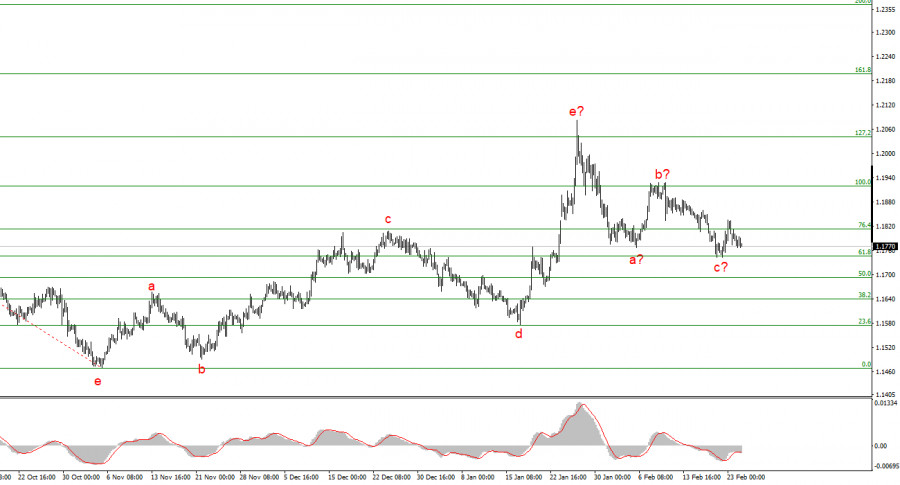
Based on my analysis of EUR/USD, I conclude that the instrument is continuing to build an upward trend segment. Trump's policies and the Federal Reserve's monetary policy remain significant factors contributing to the long-term decline of the American currency. The targets for the current segment of the trend may extend to the 25th figure. At the moment, I believe that the instrument remains within the framework of global wave 5, so I expect quotes to rise in the first half of 2026. The corrective structure a-b-c may end at any moment, as it has already taken a convincing form. I believe that it is advisable to search for areas and levels for new purchases with targets located around 1.2195 and 1.2367, corresponding to 161.8% and 200.0% on the Fibonacci.
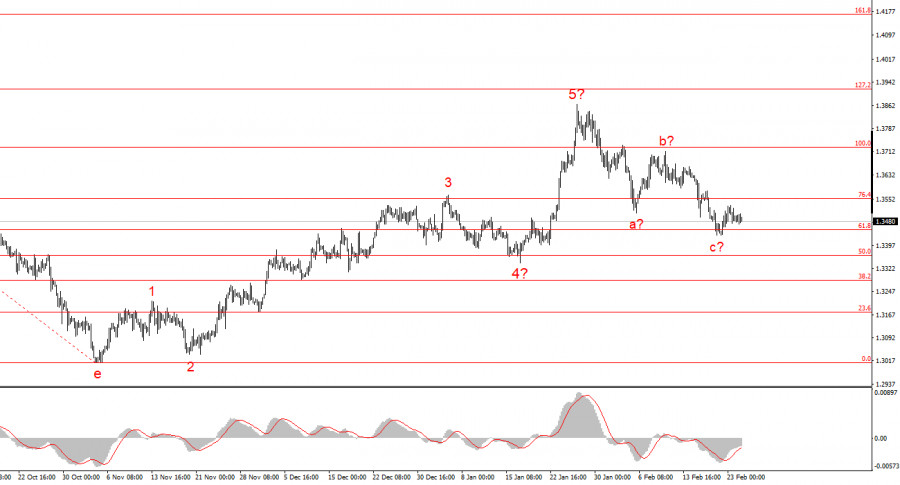
The wave analysis of the GBP/USD instrument appears quite clear. The five-wave upward structure has completed its formation, but the global wave 5 may take a much more extended form. I believe that the construction of a corrective wave set may soon conclude, after which the upward trend will resume. Therefore, I can now advise seeking opportunities for new purchases with targets set above the 39 figure. In my opinion, under Trump, the British pound has a good chance of rising to $1.45-$1.50.

ລິ້ງດ່ວນ


















 ຕິດຕໍ່ພວກເຮົາ