
The Federal Reserve released its September minutes, and the dollar mostly ignored it. The euro and pound received neither relief nor a new downward push from the document, and the evening again showed that US monetary policy and yields — not European data — are calling the shots. Compare yesterday morning with the evening: in the morning German industrial output surprised to the upside (+2.0% vs +0.5% expected) yet the euro still fell, and the pound shrugged off Lloyds' zero house-price index. In the evening, the Fed minutes confirmed that local news does not move the market while bond yields are the focus.
For the euro, the situation remains unchanged. The political risk premium around France persists, the spread between French and German yields is at its widest since 2011, and high US yields keep demand for the dollar elevated.
The Fed minutes showed what committee members debated and how they reached their decision. It is now clear the September hike to 3.75–4.00% passed unanimously, whereas in July the vote was 9–3 — the split has moved to consensus. Most participants think another hike is likely before year-end, while a few believe current policy still does not sufficiently restrain the economy. Inflation risks remain tilted to the upside. The minutes also discussed preparing tools to use in case of stress in the US Treasury market — sudden yield spikes with insufficient buyers — so we may see new firefighting measures soon. The market had expected this tone, so it did not react strongly. I think the minutes reinforced December-hike expectations while leaving October's pause as the main scenario.
Today the euro has a busy first half of the day, but one item will likely stand out: the European Central Bank's account of its September meeting. Germany will publish foreign-trade data and eurozone finance ministers will meet, but the ECB account will probably draw the most attention. It plays the same role for the ECB as the Fed minutes did yesterday — showing how council members debated — and after US unanimity, investors want to know how hard-line the Europeans are. If the ECB's tone is hawkish and signals a continued path of hikes, the euro will have a chance to recoup some losses. There are grounds for that: eurozone inflation accelerated to 3.8% in September, and the deposit rate is already 2.50%. Services and food prices are rising, so second-round effects are building. If the account is cautious, the euro will keep searching for a floor because political worries and the French-German spread work against it. The finance-ministers' meeting adds a fiscal angle, and German trade will show whether external demand can hold after strong industry prints. Even a firm ECB account, in my view, would likely only produce a limited bounce while the dollar rests on high US yields.
The pound's calendar today is all about the Bank of England. In the first half of the day, the BoE's Credit Conditions survey will be released — a banks' poll showing how easy it is for households and firms to borrow — followed by speeches from MPC member Huw Pill and Governor Andrew Bailey. The main question is how policymakers will split their focus between high inflation and a cooling labor market. The inflation side is worrying: service-sector cost pressures are strongest since June, and prices firms charge have risen fastest since May. Pill, who voted in July for immediate tightening, will probably emphasize price risks and be read as a hawk. Bailey is in a harder position, balancing both factors. The credit-conditions survey will show how expensive borrowing is weighing on demand, and Lloyds' zero house-price index already hinted at a stalled property market. I think a hawkish Pill combined with a cautious Bailey will keep the pound under pressure.
For the euro — above 1.1238, I see a path to 1.1275 and then 1.1310. The upside scenario requires a hawkish ECB report, and I only trust that move up to the first target because any rebound will be limited. Below 1.1202, targets 1.1165 and 1.1133 open. I give priority to selling, but only if price consolidates below 1.1202 — US yields and the political backdrop still favor the dollar. The range between the points is 36 pips, and before the ECB report, the pair can easily wander back and forth inside it, so I would skip first touches.
For the pound — consider long positions above 1.3221 with targets 1.3251 and 1.3279, and short positions below 1.3194 with targets 1.3161 and 1.3128. The band is 27 pips, and the pound will likely spend the morning inside it. The upside scenario triggers if Pill sounds hawkish, but I would be cautious about expecting a move beyond 1.3251 because the budget issue caps upside. The downside looks slightly more likely as the day progresses, since the dollar will have the final say tonight and the pound's supports are thin.
Today reference levels sit very close to breakout points, and it is especially easy to make mistakes here.
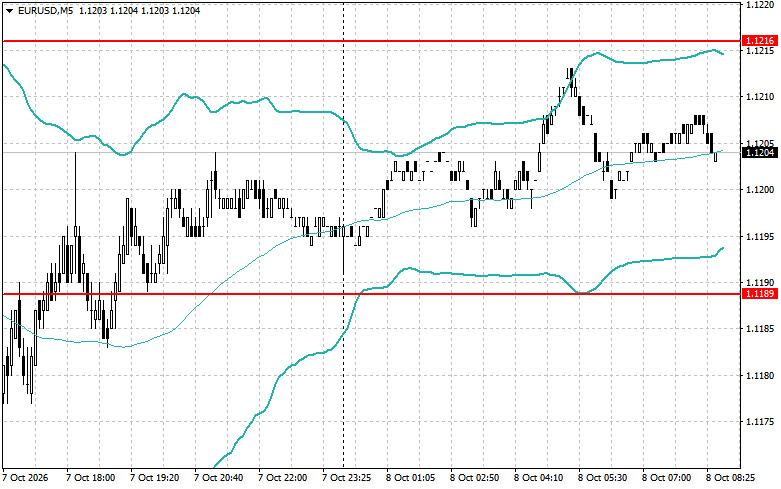
For the euro, the upper reference 1.1216 lies inside the band, 14 pips above the 1.1202 breakout and 22 pips below 1.1238. If price spikes above 1.1216, fails to hold, and returns below, I consider selling with a stop above the failed high, but treat it as a short-term trade rather than a reversal. The lower reference, 1.1189, is 13 pips below the 1.1202 breakout and on the way to the first target, 1.1165. If price moves down calmly, 1.1189 is just a stopover, and buying there is premature. I'd buy only after a poke below 1.1189 that fails to continue and then a return above 1.1202, using a stop under the poke low. Such a return is likelier if the ECB report reads neutral and the initial reaction fades.
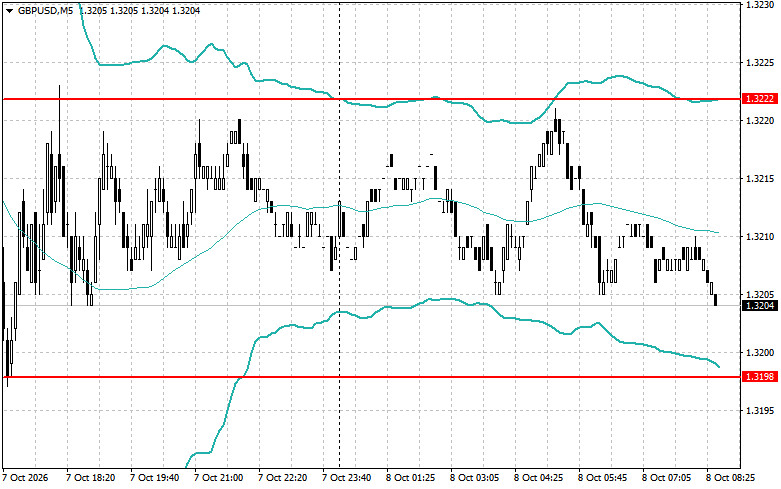
For the pound, the upper reference 1.3222 is only 1 pip above the breakout 1.3221, so novices must be extremely cautious. That gap is smaller than normal market noise, so you cannot tell a real breakout from a false one on the first touch. If price clears and holds above, the move to 1.3251 is underway, and selling is forbidden. If price spikes above 1.3222, fails to hold and falls back below 1.3221, the mean-reversion sell works with a stop above the local high. The lower reference 1.3198 sits 4 pips above the 1.3194 breakout and 23 pips below 1.3221, inside the range. If price dives below 1.3194 and consolidates, that is a downside breakout and buying is forbidden. If it pokes under 1.3198 but does not reach 1.3194 and returns above 1.3198, buys are possible with a stop under the poke low. That pound scenario is especially relevant if Pill and Bailey deliver no surprises — the first reaction may spike one way and then retrace back into the range.
ລິ້ງດ່ວນ



















 ຕິດຕໍ່ພວກເຮົາ