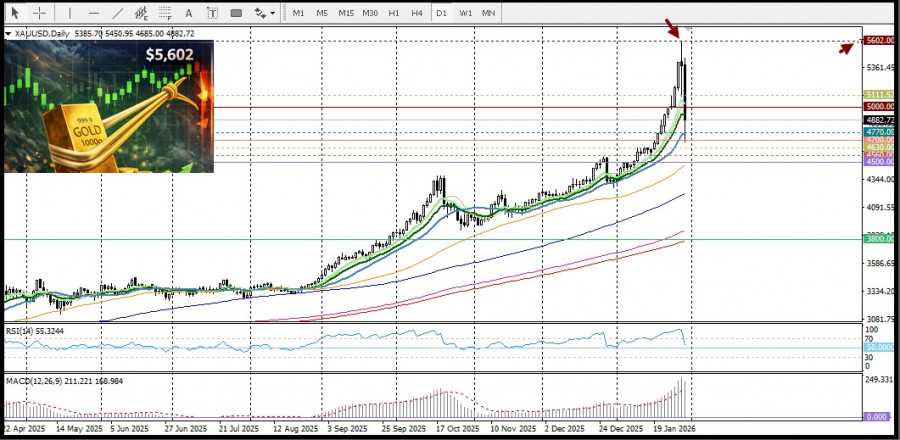
Such a scenario was not unexpected, given the significant overvaluation of both precious metals. The record one-day correction in gold occurred just a couple of days after a historic one-day surge: on Thursday, the peak of $5,602 per ounce capped the January rally at 29.5%.
Meanwhile, silver soared by 68.5% after intraday highs above $121, demonstrating a momentum whose instability at the beginning of the year has been evident from the start.
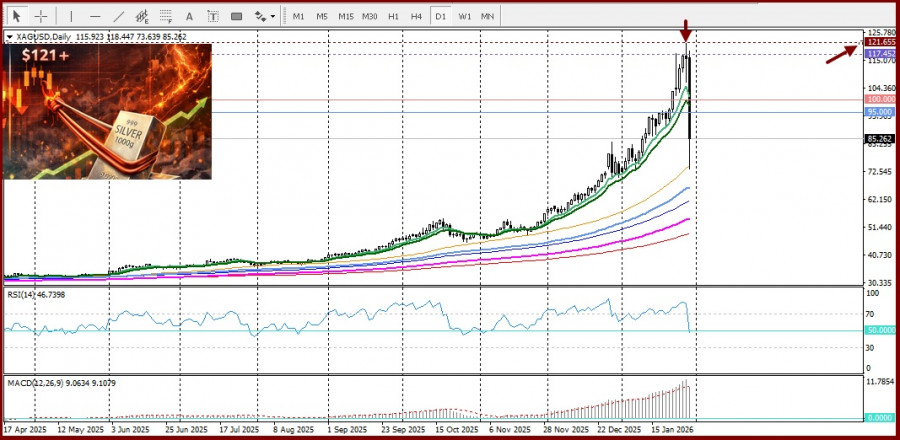
Macroeconomic factors driving gold and silver remain firmly in place. The current pullback appears to be a positional fixation within the context of an ongoing bull cycle rather than a reversal. The prospects for precious metals remain well-supported throughout 2026.
Gold retains the potential to test the $6,000 mark by year-end. As long as geopolitical turbulence persists, it will fuel demand for safe-haven assets such as gold and silver.
This pullback is likely to be perceived as a buying opportunity, as the key growth factors—soaring G7 debt, waning interest in the US dollar, trade and geopolitical uncertainty, demand for supranational hedge assets against chaos, and potential renewed inflationary pressures—remain strong.
While technical selling has occurred, the decline has been exacerbated by shifts in expectations about the US economy and interest rates. On Friday, President Donald Trump confirmed Kevin Warsh's nomination to serve as Chair of the Federal Reserve. Analysts see former Fed governor Warsh, in office since 2006, as a figure capable of bringing stability to monetary policy.
Warsh's appointment could mark a turning point for the Fed's mandate. Despite his reputation as a "hawk" on inflation issues, his approach is expected to be more nuanced, although a confrontation with Trump's pressure to lower rates is unlikely.
The President has made it clear that monetary policy needs to be eased. Attacks on the Fed are likely to continue under Warsh if expectations are not met, which increases the likelihood that the central bank will at least partially yield to pressure and lower interest rates more than currently priced into the market. This suggests that the price of gold will remain well-supported.
Despite Trump's persistent calls for rate cuts, markets remain reluctant to price in aggressive monetary policy easing. According to the CME FedWatch tool, markets still expect the first rate cut in June 2026 and incorporate only two cuts for the entire year.
HIZLI BAĞLANTILAR
show error
Unable to load the requested language file: language/turkish/cookies_lang.php
date: 2026-02-02 04:25:18 IP: 172.18.0.1

















 Bize Ulaşın