The US dollar rose, and a number of risk assets fell after a sharp spike in volatility triggered by uncertainty over future US trade policy.
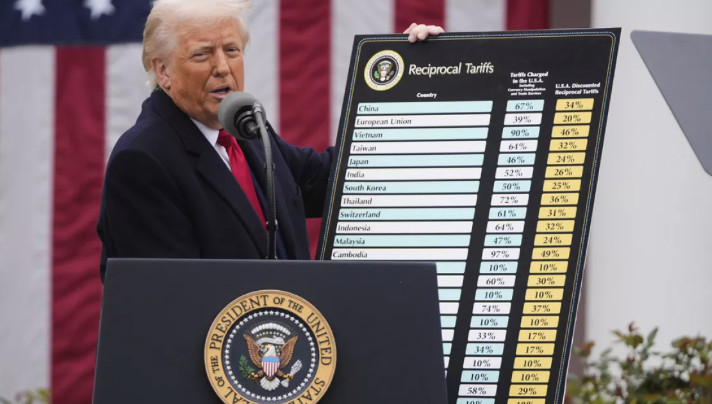
It was announced today that Donald Trump's new 10% global tariffs have come into force, marking the White House's effort to preserve the president's trade agenda after the Supreme Court curtailed his earlier broad authorities. Trump said he is applying a 10% base levy under Section 122 of the Trade Act of 1974, which allows the president to impose such a charge for up to 150 days without Congress's approval.
The move marks a new phase in trade relations, with the administration seeking to pursue its goals despite judicial limits. The additional tariffs are still presented as intended to boost domestic production and protect US companies from foreign competition. The Supreme Court's ruling requiring the president to follow statutory procedures forced the White House to pursue alternative, more legally intricate routes to implement its trade strategy. The new 10% tariffs, introduced via a mechanism not covered by the struck?down authority, demonstrate the administration's flexibility and persistence.
Last Friday, the president signed a decree authorizing a 10% import tariff just hours after the Supreme Court decision. He later threatened to raise it to 15%, but did not formally issue an order to raise the tariff rate. According to an administration representative, the White House is working on an official decree to lift customs duties to 15%, but the timing of that higher tariff has not been set.
Major trade partners, including the European Union and India, have already said they are suspending current trade talks due to the suspense.
According to estimates, the US's average effective tariff rate will now be about 10.2%, down from 13.6% before the court ruling. With a global tariff of 15%, the effective rate would be roughly 12%, the study says.
Trump's team has stated that tariffs will remain a central pillar of his trade policy and confirmed plans to launch a series of expedited investigations that would allow him to impose duties unilaterally.
As noted above, this development has supported the US dollar in FX markets.
Technical picture of EUR/USD
Buyers now need to focus on reclaiming 1.1785. Only that will allow a test of 1.1810. From there the EUR/USD pair could reach 1.1835, but doing so without support from major players will be difficult. The ultimate upside target is 1.1860. On the downside, I expect significant buyer interest only around 1.1765. If there is no buying activity there, it would be reasonable to wait for a break of the 1.1745 low or to open long positions from 1.1715.
Technical picture of GBP/USD
Pound buyers need to take the nearest resistance at 1.3500. Only that would allow targeting 1.3530, above which a further breakout will be difficult. The ultimate upside target is 1.3555. On the downside, bears will try to seize control of 1.3460. If they succeed, breaking that range would hit the bulls hard and push GBP/USD to a low of 1.3432 with the potential to extend to 1.3405.
HIZLI BAĞLANTILAR
show error
Unable to load the requested language file: language/turkish/cookies_lang.php
date: 2026-02-24 08:24:08 IP: 172.18.0.1
















 Bize Ulaşın