On Sunday, it became apparent that the war in the Middle East had resumed. Although, to be honest, it is now unclear how to properly label these events. If the parties to the conflict are exchanging reciprocal strikes, is this war or a ceasefire? What is it called in 2026? Let's stick to familiar terminology and interpretations; therefore, the war has resumed in the Middle East. Over the past few months, I have repeatedly written about key moments in the Iranian-American confrontation. At this point, they remain unchanged.
The first point is that Iran will not give up its nuclear developments. Tehran may agree to a deal similar to the one made with Barack Obama's administration, but such a deal would only involve infrequent inspections of Iranian nuclear facilities. Essentially, such a deal guarantees nothing to the Western world, and Donald Trump withdrew from a similar agreement during his first presidential term. Therefore, I see no meaningful reason for such an agreement.
The second point is that Trump wants to end the war, but only on his terms. The main condition is Iran's abandonment of nuclear developments. To achieve this, Trump is willing to unfreeze Iranian assets, lift the blockade on Iranian ports, remove oil sanctions, and basically remove any sanctions against Tehran, even financing the country's recovery. However, the problem is that Iran is unwilling to abandon uranium enrichment. Thus, the U.S. presidency is completely deadlocked. Achieving the desired military outcome is not possible, and Iran is unwilling to sign a deal on U.S. terms. What to do in such a situation? Perhaps no one knows.
Based on the above, I still believe that no real agreement will emerge. Tehran and Washington may sign another ten memorandums and introduce five new "ceasefire regimes," labeling military actions as "a ceasefire" while continuing negotiations for another couple of years. However, the actual state of affairs will not change. The conflict will become prolonged and protracted, characterized by constant reciprocal shelling. It is most likely that the Strait of Hormuz will remain blocked, or at the very least, passage through it will become a "task with asterisks" for all ships. Shipowners are unlikely to want to risk their vessels, and insurance companies will have difficulty covering such shipments. Additionally, Iran and Oman might impose a fee for passage through the Strait, further driving up prices for any cargo, including oil.
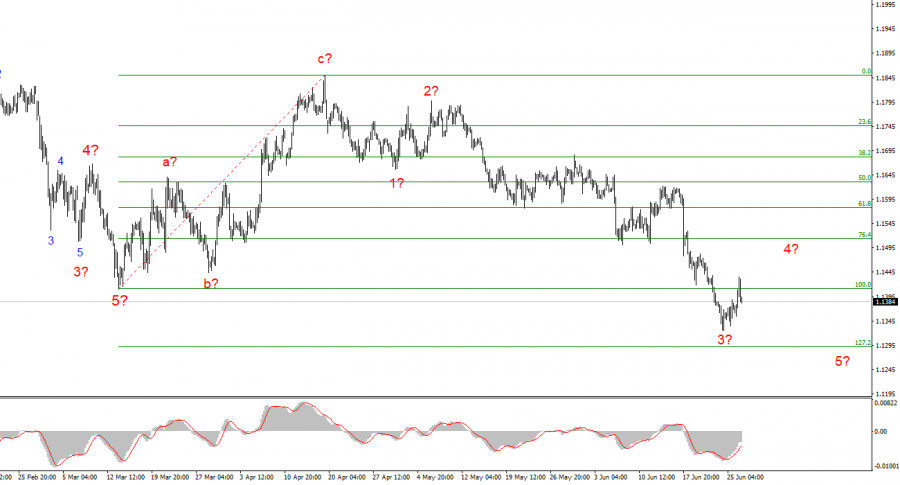
Based on the conducted analysis of EUR/USD, I conclude that the instrument remains within an upward segment of the trend, while in the short term, it is within a downward segment of the trend. In my opinion, now is a good time to try forming long positions, but the instrument may drop much lower than 14 figures in the context of wave C. If this assumption is correct, it would be better to wait a little longer, at least for wave 5 in C. However, wave counting often brings surprises, so I would start adjusting to buying now.
The wave picture of the GBP/USD instrument has become clearer. Currently, the instrument has built three waves down, and the wave count for EUR/USD has changed, so three waves have also been constructed there. Therefore, the British pound may resume its decline within wave 5 in C after a small correction within wave 4. One way or another, the downward wave formation may conclude soon, and the news background does not provide unconditional support for the U.S. currency. The unsuccessful attempt to break above 1.3157, which corresponds to 100% on the Fibonacci scale, suggests the instrument's readiness to rise. The pound's issue again lies in geopolitics.
HIZLI BAĞLANTILAR
show error
Unable to load the requested language file: language/turkish/cookies_lang.php
date: 2026-06-29 04:13:36 IP: 172.18.0.1







 Bize Ulaşın