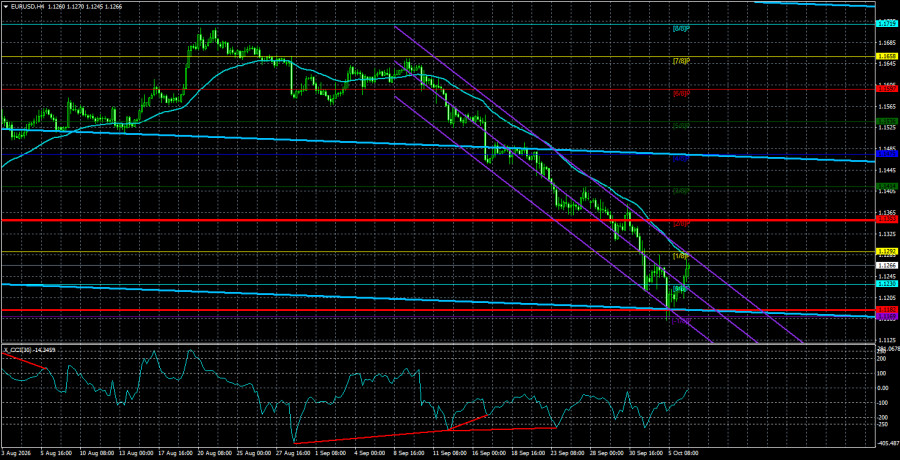
The EUR/USD currency pair unexpectedly rose on Tuesday. Of course, nothing lasts forever, but over the past month traders have probably grown unaccustomed to prices moving anything other than down. The fact remains: the US dollar weakened on Tuesday — one of the rare instances over the last month. The only question now is how far the dollar will fall.
In general, we consider the current price levels excellent for the start of a new, prolonged uptrend. We still see no compelling reasons for further dollar strength—and we didn't see any even during the past month. If the dollar had risen 100–200 pips on the Federal Reserve tightening factor, that would be logical and reasonable. But the dollar rose almost 500 pips despite a pile of factors that support the euro.
Yesterday, for example, the market was busy pricing the French budget crisis and the start of a war in Yemen. Before that came geopolitical tensions — which in truth are not that clear — and a "hawkish" Fed stance that effectively no longer exists. Remember, the Fed raised the policy rate at the September meeting, but then effectively stepped back from further tightening in October. Recent US macro data also indicate we should not expect a hike at the next meeting.
Why? First, FOMC members see no reason to rush rate increases. The tightening cycle has begun, but that doesn't mean rates must rise at every meeting. Second, US macro data do not demand rapid further tightening. The Fed's preferred inflation gauge, the PCE index, showed no increase in August, and the US labor market again disappointed.
On those two bases, we strongly doubt the Fed will tighten in December. Imagine unemployment continues to rise, Nonfarm Payrolls keep printing near zero, and inflation does not accelerate further — or even if it does, labor market weakness remains. Would the Fed keep raising the policy rate while unemployment rises and job creation is negligible? It's possible, but there are good reasons to doubt it.
The technical picture is unambiguous on the daily and weekly timeframes. On those charts, we see a complex correction that should have ended long ago and a clear, strong uptrend. From our perspective, the situation is obvious: expect the correction to finish and the uptrend to resume. Lately the market has largely forgotten about a source of pressure on the dollar — Trump's policy — and that's a mistake. We believe that factor alone could keep the US currency falling for a long, drawn-out period. Many experts have recently re-calibrated to expect dollar strength. Well — earlier this year many of them expected euro strength...
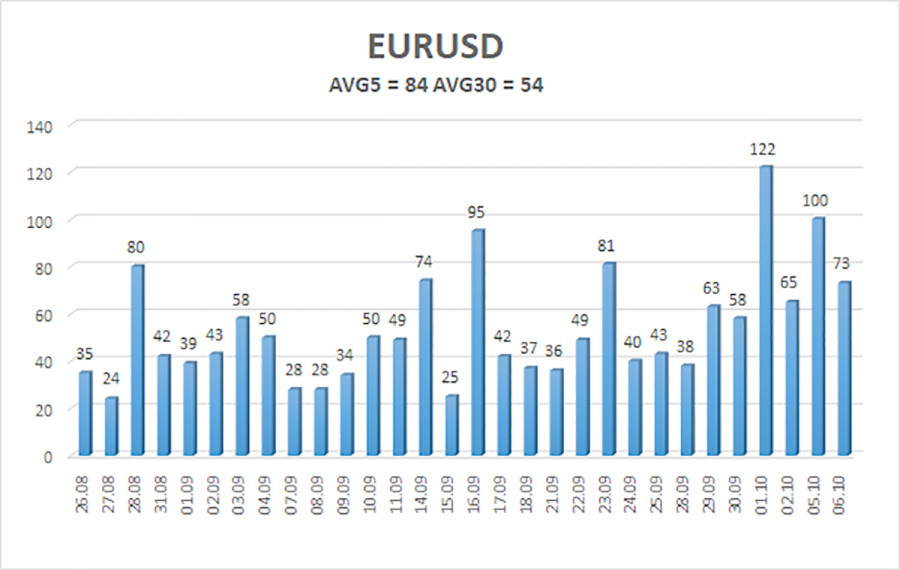
The average volatility of the EUR/USD currency pair over the last 5 trading days as of October 7 is 84 pips and is characterized as "average." We expect the pair to move between 1.1182 and 1.1350 on Wednesday. The higher linear-regression channel has turned sideways, indicating another trend change. The CCI indicator entered the oversold area three times and formed three "bullish" divergences, which warn of the end of the illogical downtrend. However, the market is not responding to technical signals.
S1 – 1.1230
S2 – 1.1169
S3 – 1.1108
R1 – 1.1292
R2 – 1.1353
R3 – 1.1414
The EUR/USD pair continues to move downward, but we still view the pair's decline as a correction before a new uptrend. The global fundamental backdrop for the dollar remains negative, but in 2026, geopolitical events first, and then the Fed's "hawkish" stance, provided strong support to the US currency. When the price is below the moving average, consider short positions with targets of 1.1182 and 1.1169. Above the moving average line, long positions are relevant, with targets of 1.1353 and 1.1414.
HIZLI BAĞLANTILAR
show error
Unable to load the requested language file: language/turkish/cookies_lang.php
date: 2026-10-07 06:24:53 IP: 172.18.0.1

















 Bize Ulaşın