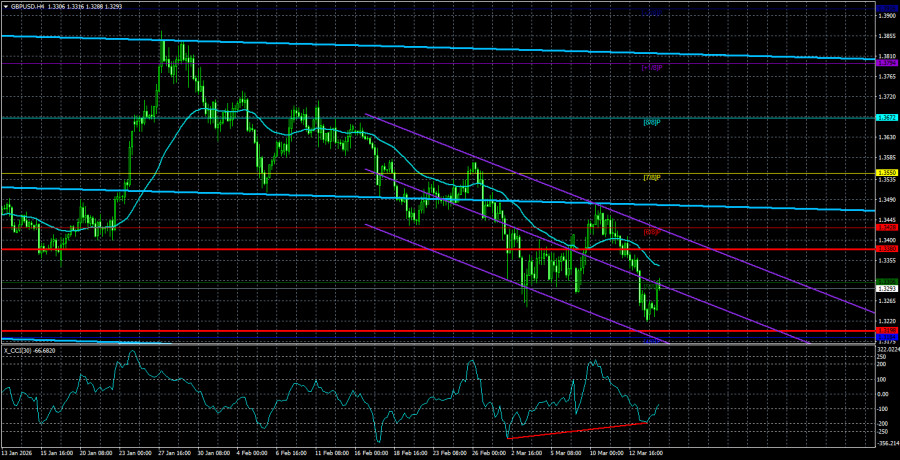
The GBP/USD currency pair demonstrated a minimal correction on Monday, while the British currency has been in decline for a month and a half. Thus, a rise of 50-60 pips means practically nothing. Naturally, even with such a strong geopolitical backdrop as the current one, prices must occasionally correct. This is a market mechanism that cannot be undone. However, at this time, understanding what we are dealing with is nearly impossible. The problem is that only the geopolitical factor is working in the dollar's favor. If that factor were removed, the American currency would plummet back into the abyss very quickly.
Consider this: the American economy is slowing down, the labor market shows no signs of life even after three rate cuts, unemployment is rising again, and Trump's policies... have already been discussed so much over the past year that there's little left to add. His policies are destructive not only for the US but for the entire world. Therefore, we do not understand who would voluntarily buy dollars if it weren't for the geopolitical factor. Over the last month, the market has simply remembered that during serious geopolitical conflicts, one must save one's assets. A choice had to be made about which currency to move them to. The euro, with the likely energy crisis in the Eurozone? The British pound, the franc, or the yen, which are currencies of relatively small countries? Bitcoin? Investors had no real choice. The dollar is unattractive, but it still remains a pillar of the global financial system. If it weren't for the war in Iran, we would never have seen such a strong rise in the American currency.
This week, the US will hold another FOMC meeting. Markets believe that the "dovish" stance for 2026 from the monetary committee will weaken significantly, as the risks of rising inflation have increased significantly over the past few weeks. If the Fed adopts a more hawkish stance on monetary policy, the dollar will receive additional support for growth. However, we want to point out that inflation can accelerate not only in the US. For example, in the Eurozone, which is much more dependent on energy imports, inflation will also rise. Other countries are not exceptions either, meaning their central banks will also shift their tone from "dovish" to "hawkish." Therefore, we do not believe that the Fed's hardening of views will support the dollar.
We generally do not think that monetary policy can influence movements in the currency market at this time. Markets remain in a state of complete uncertainty due to events in the Middle East, so central bank actions are currently of less interest to traders. Of course, on Wednesday evening or Thursday morning, we may see a market reaction to the FOMC meeting. However, it's unlikely that the Federal Reserve will change its monetary policy parameters. What is interesting are Jerome Powell's comments and the "dot plot," which will reflect the FOMC officials' sentiment for the next year or two.
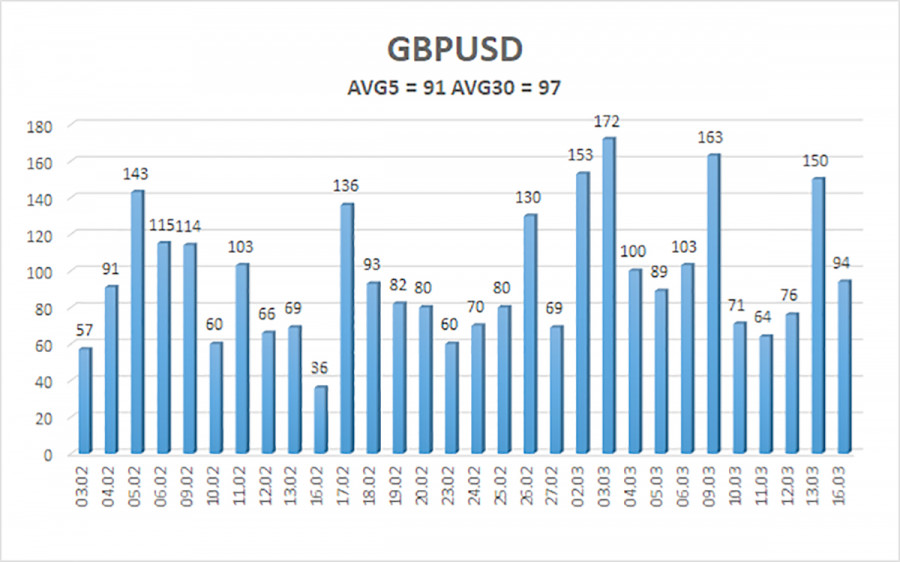
The average volatility of the GBP/USD pair over the last 5 trading days is 91 pips. For the GBP/USD pair, this value is considered "average." Thus, on Tuesday, March 17, we expect the pair to move within a range limited by levels 1.3198 and 1.3380. The upper linear regression channel has turned sideways, indicating a trend reversal. The CCI indicator has once again entered the oversold area, signaling a potential end to the correction; however, even technical signals are currently of little significance.
S1 – 1.3184
S2 – 1.3062
S3 – 1.2939
R1 – 1.3306
R2 – 1.3428
R3 – 1.3550
The GBP/USD pair continues to correct after a month and a half, but its long-term prospects have not changed. Trump's policies will continue to exert pressure on the US economy, so we do not expect the US currency to grow in 2026. Thus, long positions with targets at 1.3916 and above remain relevant if the price is above the moving average. If the price is below the moving average line, small short positions can be considered with targets at 1.3198 and 1.3184 based on geopolitical factors. In recent weeks, nearly all news and events have been bearish for the British pound, resulting in a prolonged correction.
Linear regression channels help determine the current trend. If both are directed in the same way, it means the trend is currently strong;
The moving average line (settings 20,0, smoothed) determines the short-term trend and the direction in which trading should currently be conducted;
Murray levels are target levels for movements and corrections;
Volatility levels (red lines) indicate the likely price channel in which the pair will operate over the next 24 hours based on current volatility indicators;
The CCI indicator—its entry into the oversold area (below -250) or the overbought area (above +250) suggests that a trend reversal in the opposite direction is approaching.



















 আমাদের সাথে যোগাযোগ করুন