Tonight, the results of the penultimate Fed meeting of the year will be known. The market has continued to buy the dollar ahead of the event—the currency has risen more
Tonight, the results of the penultimate Fed meeting of the year will be known. The market has continued to buy the dollar ahead of the event—the currency has risen more than 1 cent just in the last two days. As I've noted, wave counts and the news backdrop contradict the recent price decline. But what should we expect for EUR/USD after the FOMC? This note tries to answer that.
If we attempt an impartial read of the situation, the dollar looks set to keep rising. If the market buys the dollar even while pricing a hold, what else would it do after the meeting? Remember the next Fed tightening will not happen before December and would be only the second step in the current cycle. The dollar has already risen so strongly in the past two months that those two rounds of tightening can be considered largely priced in.
Still, I do not believe an entirely baseless dollar rally can last forever. The current wave count can be adjusted so that the present move becomes wave 5 of E. That leaves room for a favorable completion of the structure. On that basis I expect EUR/USD will not fall below 1.1082—the 161.8% Fibonacci level—and a failed attempt to break that mark should be a buy signal for traders.
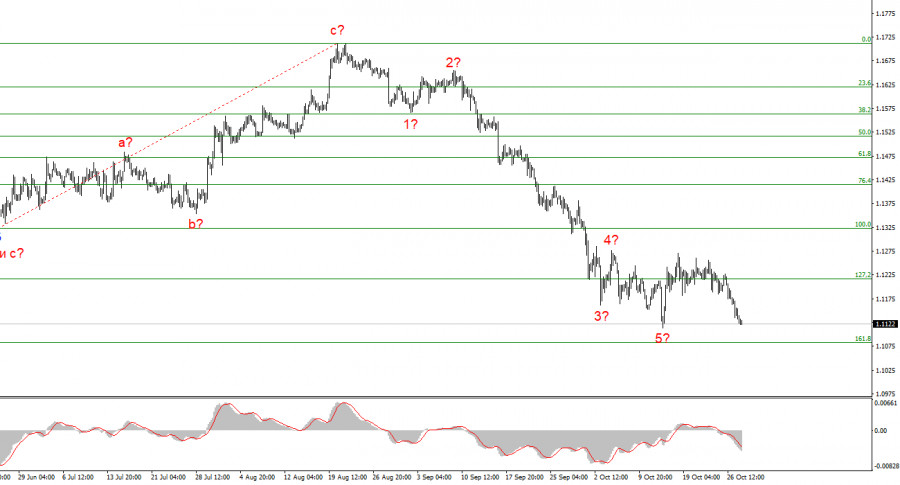
If I am wrong and the market keeps buying dollars after the FOMC, we would be in a "free-fall" regime where market participants ignore fundamentals and mechanically hit the same buy button every day. That is more or less how the market has behaved over the past two months. At first the dollar's rise could be explained by the Fed tightening, hawkish Fed plans, unrest in France, or Paris's budget issues; now time has passed and the euro just keeps falling.
Given all of the above, my base case remains a transition toward building a genuine bullish leg, and I plan to look for buying opportunities in the near term. However, a successful break below 1.1082 would force me to revise that view for EUR/USD.
Other articles to read:
EUR/USD analysis. Oct 28. Selling continues
Wave picture for EUR/USD
My analysis suggests EUR/USD remains inside a global A-B-C-D-E corrective segment. That structure now looks complete and may be finished. I believe now is a good time not only to buy the euro but also to expect a full bullish leg. On the higher timeframe, one should expect a rise to at least the 1.17–1.18 area. The failed attempt to break 1.1126, equal to a 50.0% Fibonacci retracement (lower chart, higher timeframe), also signals the market's readiness to buy.
Wave picture for GBP/USD
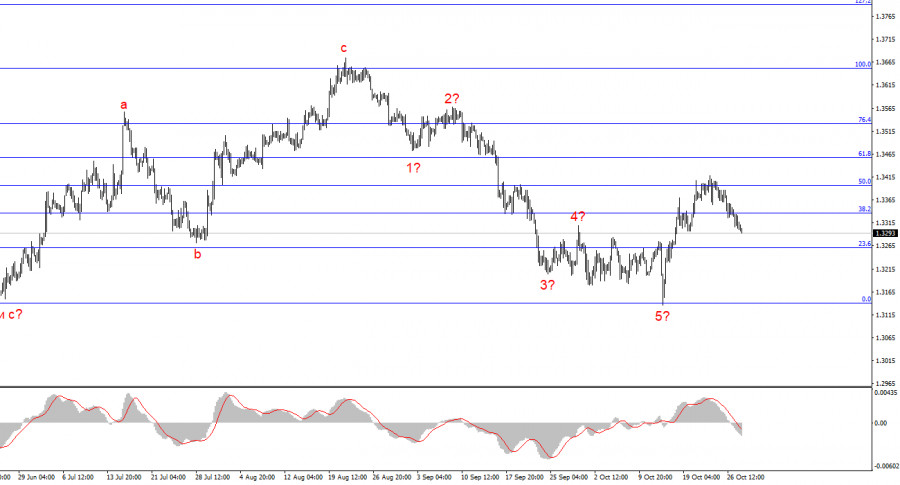
The wave structure for GBP/USD has become fairly clear. Charts show a distinct A-B-C-D-E corrective pattern that may be complete. If that assumption holds, sterling has concluded the decline that worried many traders recently. In that case the pound could begin not only a corrective wave but also a full bullish leg with targets above the peaks of waves B and D—i.e., above the 1.37 area. I consider now a good time to build long positions.
Core principles of my analysis:
1) Wave structures should be simple and comprehensible. Complex structures are hard to trade and often change.
2) If you are not confident about what is happening in the market, it is better not to enter.
3) There is never 100% certainty about direction; do not forget protective stop-loss orders.
4) Wave analysis can be combined with other analytical methods and trading strategies.

TAUTAN CEPAT









 Hubungi kami