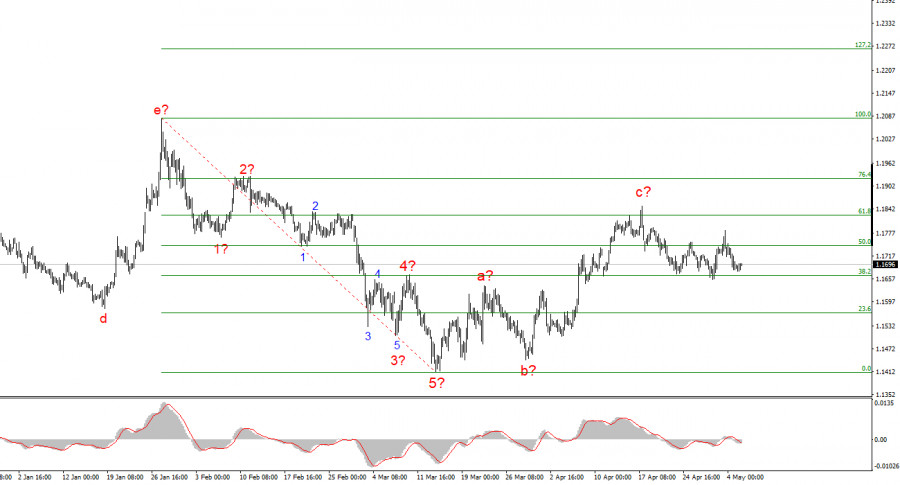
The wave pattern on the 4-hour chart has changed somewhat. There is still no indication that the upward trend segment (shown in the lower chart), which began in January of last year, has been canceled. However, the wave structure now appears rather ambiguous. In such situations, I recommend switching to a lower timeframe (upper chart) and focusing on simpler, smaller wave structures to make short-term forecasts, which are sufficient for opening trades. Wave structures can become highly complex and allow for multiple scenarios. The easiest approach is to trade based on standard "five-three" patterns.
In the chart above, a classic five-wave impulse structure can be identified, with an extended third wave. After its completion, a corrective structure of at least three waves began to form. We have already seen three waves, so the market is likely to develop at least one more downward corrective wave in the near term. Future developments will depend on geopolitics: either a continuation and complication of the upward structure, or the formation of a new downward trend segment.
On Tuesday, EUR/USD rose slightly, but volatility remained very low. On Monday, the market reacted only weakly to the escalation of the Middle East conflict, although, to be fair, the escalation itself also appeared limited. It seems both sides exchanged symbolic strikes "as a warning," and that may be the extent of military action—for now, at least. Many global media outlets continue to report that negotiations between Tehran and Washington are ongoing via phone. If that is true, further escalation is not in anyone's interest.
Of course, the current situation in the Middle East is beneficial for Donald Trump, as the United States is increasing exports of LNG and oil—at elevated prices—taking advantage of a global energy shortage that it helped create. However, while additional budget revenue is positive, American consumers are becoming increasingly frustrated by rising inflation and high fuel prices. The longer prices remain elevated, the fewer voters may support Republicans in November.
It is clear what Trump is aiming for: to financially weaken Iran by restricting its oil exports. With about six months until the elections, there is still time for this strategy to play out. And, as the saying goes, "winners are not judged." If the Strait of Hormuz is reopened, oil prices could fall, and the public may quickly move on from the current situation. For now, a de-escalation scenario seems the most desirable outcome.
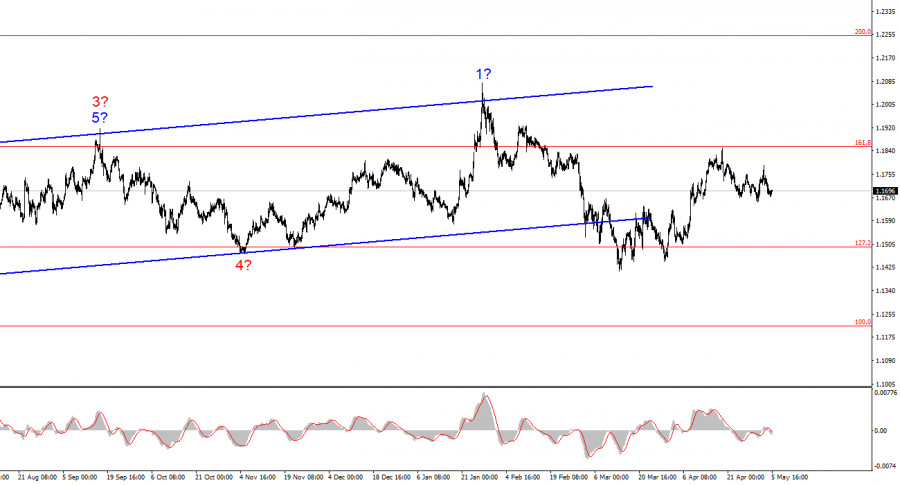
Based on this EUR/USD analysis, the pair remains within an upward trend segment (lower chart), while in the short term it is moving within a corrective structure. The corrective wave pattern appears largely complete but could become more complex and extended if the geopolitical situation in the Middle East does not worsen this week. Otherwise, a new downward trend segment could begin from current levels.
We have already seen a corrective wave, and I expect a renewed upward move from current levels, with targets around the 1.19 area.
On a smaller timeframe, the entire upward trend segment is visible. The wave structure is somewhat unconventional, as corrective waves differ in size. For example, the higher-degree wave 2 is smaller than the internal wave 2 within wave 3. Such cases do occur. It is best to focus on clear and understandable structures rather than trying to label every wave precisely. Recent waves are particularly difficult to identify, so I rely more on the higher timeframe in my analysis.
Key Principles of My Analysis


















 コンタクトする