August 17 marks the day when the Memorandum of Understanding between the US and Iran expires. It is evident to all market participants that this document has long lost its significance, as both sides of the conflict have violated it ten times. However, until August 17, Tehran and Washington could restrain their military aggression based on this treaty; after this date, there will be nothing to hold them back. That said, neither Tehran nor Washington is eager to renew the war. Iran understands that it currently holds the initiative, while Donald Trump realizes that any new escalation would further diminish the Republican Party's chances in the upcoming Congressional elections. Therefore, no one is inclined to resume the war at this moment.
As I have mentioned many times, the best solution for everyone is a "freeze." In fact, the conflict is already frozen. Trump stated last week that he had chosen a "wait and see" strategy. And the President intends to wait for the economic collapse of Iran. It is worth noting that this position is extremely advantageous for Trump. Everyone in the world understands that there will be no economic collapse in Iran. The country has managed to survive in the most challenging conditions, as demonstrated over the past 50 years. However, for Trump, this explanation justifies why the US is not intensifying pressure on Iran while also remaining engaged in the conflict. The confrontation continues, but Washington is now opting for economic pressure.
Additionally, it should be noted that Iran and Oman have reached an agreement regarding the Strait of Hormuz, but it holds no real significance. The US maintains a naval blockade of Iranian ports, so Iran and Oman could open the strait as much as they want; it will remain blocked. Interestingly, Trump stated last week that the Strait of Hormuz was no longer just "completely safe and under control of the US Navy," but "will soon become the property of the US." I am not sure how accurate this statement is, but the US does not plan to leave the Persian Gulf.
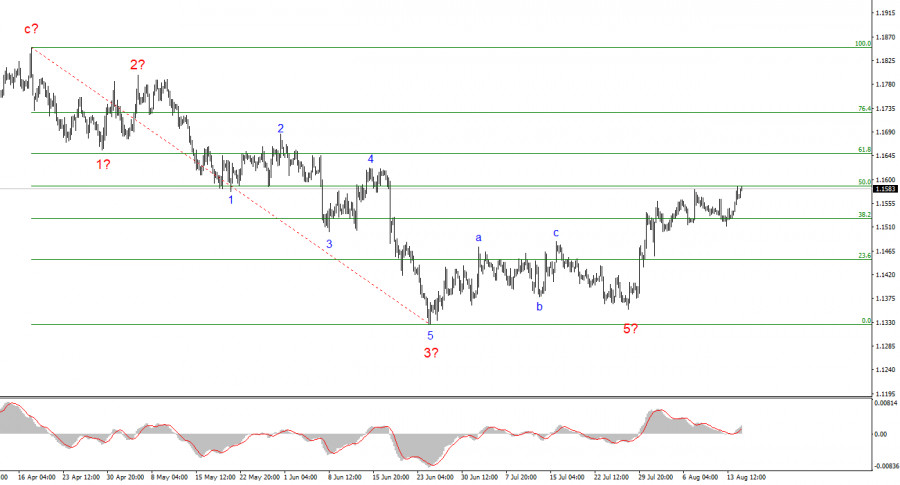
Based on all of the above, I believe that the probability of conflict resuming is now as low as the probability of a complete ceasefire and new negotiations. That is, practically zero. Trump needs to prepare for the elections while simultaneously ensuring that the Federal Reserve does not begin tightening monetary policy. The absence of geopolitical tension and weak prospects for interest rate increases may continue to exert downward pressure on the US currency.
Based on the analysis of EUR/USD, I conclude that the instrument remains within the upward section of the trend and has presumably shifted to a new upward set of waves in the short term. In my opinion, this is an excellent time to form long positions. Wave 5 in C has taken on a shortened form. If the downward section of the trend that began on January 28 does not take on a more extended, five-wave form (for which a strong news background favorable for the dollar is required), the EUR/USD instrument is at the very beginning of a new, long upward trend, with targets scattered up to the 25 figure.
The wave picture of the GBP/USD instrument has taken on a completely understandable form. We now see a clear corrective structure A-B-C on the charts, which is complete. Therefore, I expect the formation of an upward set of waves that takes on an impulsive look and coincides with the impulsive structure of the EUR/USD instrument. If this is the case, the pound is currently in the third wave, and the targets for the entire trend segment are above the 39 figure. In the coming months, I consider only trading to the upside.
ລິ້ງດ່ວນ












 ຕິດຕໍ່ພວກເຮົາ