Podle BCA Research se členové Federálního rezervního systému rozdělili na dva tábory, pokud jde o vývoj úrokových sazeb. Sedm členů výboru očekává, že letos nedojde k žádnému snížení sazeb, zatímco osm počítá s celkovým poklesem o 50 bazických bodů do konce roku 2025. První skupina se obává, že nová vlna celních opatření navrhovaných Donaldem Trumpem může v příštích měsících výrazně zvýšit inflační tlak. Druhá skupina považuje tento efekt za dočasný a méně závažný. Analytici BCA se přiklánějí k druhému táboru a tvrdí, že firmy zatím nemají tendenci zdražovat, pokud k tomu nebudou donuceny vyššími náklady kvůli clům.
Fed ponechal ve středu základní úrokovou sazbu beze změny v pásmu 4,25–4,5 %, i když aktualizované projekce stále počítají se snížením sazeb v letošním roce. Takzvaný „dot plot“ ukázal očekávání dvou snížení po 25 bazických bodech, což odpovídá předchozím odhadům z března a prosince. Tempo snižování v roce 2026 a 2027 bylo ale zpomaleno, což signalizuje, že boj s inflací bude zřejmě delší, než se původně očekávalo.
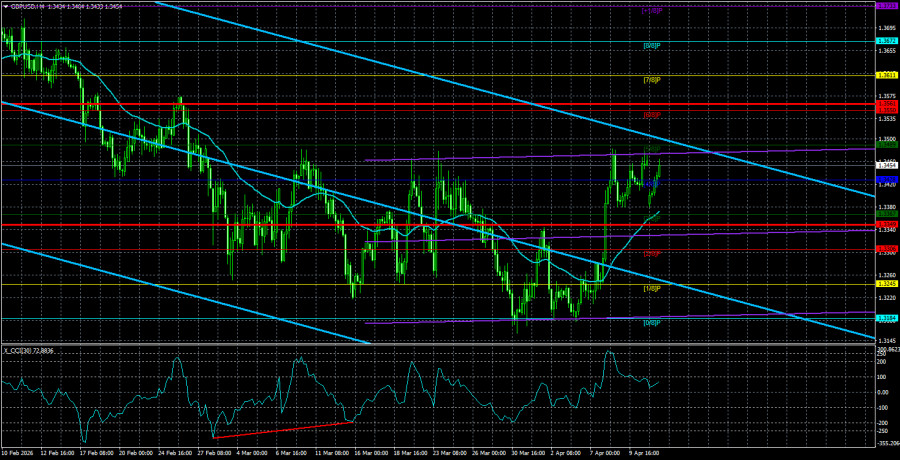
The EUR/USD currency pair failed to extend its upward movement on Monday as expected, opening the week with a 60-pip gap down. While some might see a 60-pip rise in the US dollar as relatively weak, it's important to note that this increase occurred within just 5 minutes of market opening on Monday. Furthermore, it could continue to rise throughout the week. As we've discussed many times, the macroeconomic and fundamental backdrop has not influenced the currency market for the past two months. What else can traders react to if not geopolitics?
The failure of negotiations in Islamabad left a strange aftertaste. Washington and Tehran, as expected, failed to reach an agreement on key issues related to nuclear energy and the Strait of Hormuz. As a bonus, Iran demanded that Israel stop attacking Lebanon. However, the negotiations were not formally concluded. Many media outlets reported on Monday that a second round of talks could take place as soon as Tuesday or Wednesday. And there could be as many rounds as necessary. There is a chance for peace, but it is rather elusive.
From our perspective, the number of rounds of negotiations matters less than the positions of Iran and the US. An agreement can only be reached if both parties genuinely desire to do so, which does not appear to be the case. Consider that America requires Iran to abandon its nuclear developments and all enriched uranium, demands that Trump has made since last year. The war in the Middle East began after Tehran refused to comply with these ultimatums. What are the chances that Tehran will abandon its nuclear ambitions during negotiations? Zero.
The same applies to the Strait of Hormuz. Iran understands that blocking the strait is one of its main bargaining chips. Furthermore, due to the blockade of the Strait of Hormuz, Iran can demand higher prices for its oil exports, as the price of oil has already increased (and could rise even more) due to the oil shortage in the Middle East, which arose partly because Iran bombed many oil and gas facilities in neighboring countries.
Trump wants Iran to abandon its nuclear energy program and completely open the Strait of Hormuz. But what is Trump prepared to offer in return? Reparations? No. Security guarantees? Doubtful. Complete lifting of sanctions? Unlikely. For Iran, nuclear fuel is a guarantee of its own security, so under any circumstances, Tehran will not abandon uranium enrichment. In our view, any negotiations are inherently unlikely to be successful.
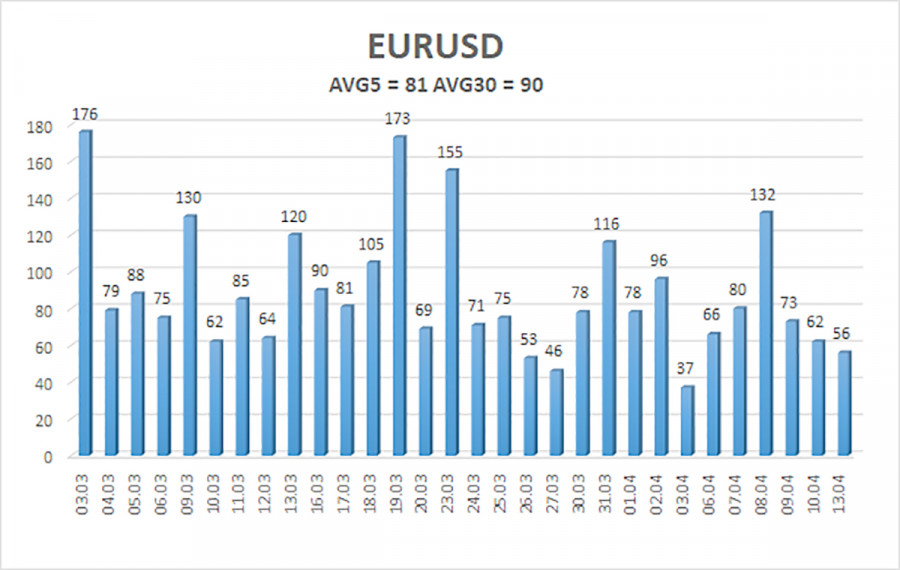
The average volatility of the EUR/USD pair over the last five trading days as of April 14 is 81 pips, which is "average." We expect the pair to move between levels 1.1629 and 1.1791 on Tuesday. The upper regression channel has turned downward, indicating a bearish trend. However, an upward trend may already resume. The CCI indicator has entered the overbought zone, signaling a possible near-term downward correction.
S1 – 1.1658
S2 – 1.1597
S3 – 1.1536
R1 – 1.1719
R2 – 1.1780
R3 – 1.1841
The EUR/USD pair has begun an upward movement, but its continuation will again depend on geopolitics. The global fundamental backdrop for the dollar remains extremely negative; however, over the past two months, the market has focused solely on geopolitics, rendering other factors practically inconsequential. If the price is below the moving average line, consider short positions targeting 1.1597 and 1.1536. Above the moving average, long positions are relevant with targets at 1.1791 and 1.1841. The market is slowly moving away from the geopolitical factor; familiar economic factors may come to the forefront in the near future.
Regression channels help determine the current trend. If both are directed in the same way, it indicates a strong trend.
The moving average line (settings 20.0, smoothed) defines the short-term trend and direction in which trading should proceed.
Murray levels serve as target levels for movements and corrections.
Volatility levels (red lines) indicate the probable price channel in which the pair is likely to trade over the next day, based on current volatility readings.
The CCI indicator's entry into the oversold area (below -250) or the overbought area (above +250) indicates that a trend reversal in the opposite direction is approaching.
SZYBKIE LINKI




















 Skontaktuj się z ForexMart