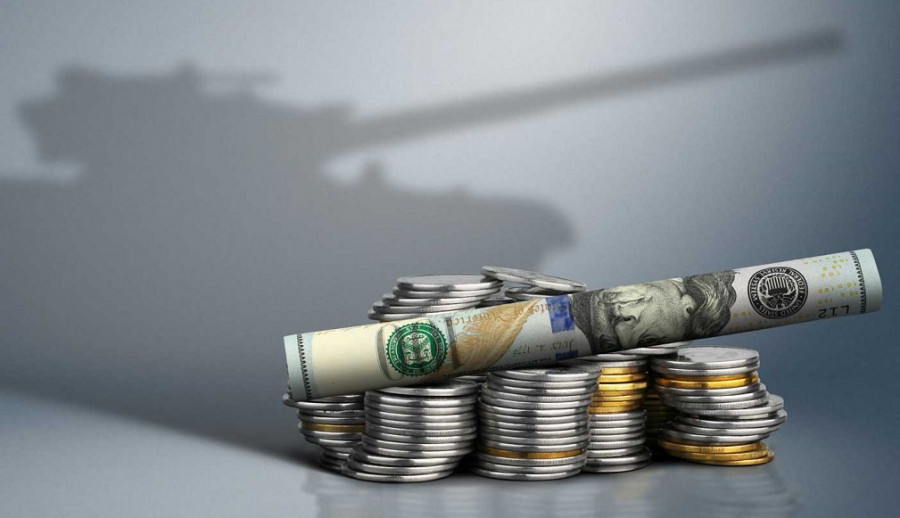
The economic calendar for the upcoming week is filled with important releases for the EUR/USD pair. The first week of each month is traditionally the most informative for traders. The calendar includes the American ISM indices, the Eurozone inflation growth report, and key U.S. labor market data.
However, given recent events in the Middle East, macroeconomic data will take a back seat. Even the most significant reports will play a secondary role amid geopolitical developments. Published macro reports will certainly remind us of their presence—but only when the "guns go silent." When that will happen is unknown. This is perhaps the key question for market participants that will linger throughout the upcoming week.
As is known, the United States, in a joint air and missile operation with Israel, struck the residence of Ayatollah Ali Khamenei. As a result of this attack, the supreme leader of Iran was killed. On Sunday, Iranian authorities officially confirmed his death. High-ranking officials, including military leaders (specifically, the country's defense minister), were also eliminated.
In response, Tehran has initiated a massive attack using ballistic missiles and drones, targeting not only Israel but also American military bases and other sites in the UAE, Qatar, Bahrain, Kuwait, and Iraq. There are also unconfirmed reports that Iran struck the capital of Saudi Arabia, Riyadh. Meanwhile, the head of the Iranian National Security Council, Ali Larijani, has threatened a "severe blow," hinting that the current military actions are just a prelude to a more extensive response.
For the currency market, including the EUR/USD pair, three factors are critically important: the duration of the conflict, its geographical expansion, and the situation around the Strait of Hormuz, through which almost one-fifth of the world's oil and gas passes.
According to The Financial Times, shipping through the strait has begun to slow—only a few large oil tankers passed through last night, while most vessels have halted. On the other hand, officials from the IRGC stated on Sunday that the Strait of Hormuz is open for tankers "until further notice." They warned that American military ships are "legitimate targets" for Iranian strikes.
In other words, it cannot yet be said that the vital transport artery is fully closed. However, even the mere threat of blocking tankers in the Persian Gulf and concerns that vessels may become targets for attacks will likely affect the oil market. This is enough for producers, traders, and transporters to reconsider their oil and LNG supply routes, with all the ensuing consequences, including those related to pricing.
Regarding the duration of the conflict, there is no consensus on its further prospects. Optimists (including some representatives from the White House) believe that the "decapitation" of the regime and massive strikes will lead to the swift collapse of the governing system. However, it is essential to consider that Iran has a complex power structure, intertwining religious and secular branches. The death of a few key figures will not lead to a breakdown in governance. Notably, a temporary acting leader of Iran (Alireza Arafi) was appointed today.
All this indicates that there are currently no signs that events will unfold according to a hypothetical Venezuelan scenario. This scenario would be the most favorable for EUR/USD buyers due to increased demand for risk and commodity assets.
Many analysts paint a grimmer picture, stating that airstrikes without a ground operation rarely lead to regime change. They believe that Iran will transform into a large zone of fragmented resistance, where proxy groups (such as Hezbollah and the Houthis) will terrorize American/Israeli tankers and US military bases for months, or possibly years. The implementation of this scenario may lead to a significant and prolonged strengthening of the dollar, making it in demand as a safe asset. Additionally, rising oil prices will accelerate inflation in the United States, leading the Fed to adopt a more hawkish stance.
There's also a darker scenario that involves a US ground operation. While the "Venezuelan" option would suggest a quick regime change, the "Iraqi" scenario would plunge everyone into a geopolitical black hole for many months, perhaps even years. In such a case, the conflict would not be localized within Iran: Shia cells in Iraq, Lebanon, and Yemen would wage a war of attrition against American infrastructure and that of its allies, making it impossible to restore oil production to previous volumes.
The "beneficiary" of this scenario will also be the safe dollar, but only until the United States faces serious human losses. A protracted war that was not initially sanctioned by Congress could provoke a political crisis—up to and including Donald Trump's impeachment. In such a case, the greenback would again fall out of favor.
Thus, "in the moment," the beneficiary of the current situation will undoubtedly be the dollar, fueled by a sharp increase in risk-averse sentiment. Trading on Friday ended on the hope that additional negotiations between the US and Iran, scheduled for Monday in Vienna, would reduce tensions. But, as they say, "tomorrow there was war."
Given the suddenness, scale, and unpredictability of today's events, one can be sure that the dollar will significantly strengthen its positions across the market on Monday, including against the euro. All other fundamental factors will take a backseat. The movement vector for EUR/USD will now be primarily determined by the prospects of a large-scale conflict and the willingness of the parties to sit down at the negotiating table. As of now, neither side shows such willingness, so a dollar rally is likely in store.
RÁPIDOS ENLACES












 Contáctenos