
Last Friday, equity indices closed with another sharp rout. The S&P 500 fell by 1.67%, while the Nasdaq 100 dropped by 2.15%. The Dow Jones Industrial Average plunged by 1.73%.
Stocks extended weakness and oil prices rose amid a deterioration of geopolitical tensions in the Middle East. The entry into the conflict of Iran-backed Houthi forces, together with an expanded US military presence, stoked fears of a protracted confrontation, which predictably weighed on investor sentiment. In such an environment, with risks rising, many investors prefer to shift capital into more conservative assets.
Following a rise in energy prices, government bonds showed steady gains. Increased demand for this asset class reflects its reputation as a safe haven during periods of uncertainty. Investors seeking to mitigate risk view bonds, particularly sovereign debt, as a way to preserve capital and secure predictable income despite broad market volatility. The risk of higher interest rates in the United States also strengthens demand for fixed income.
Earlier today, the Asian equity index fell by 2.1% on concerns that higher oil will hurt economic growth. S&P 500 futures recouped earlier losses, rising by about 0.1%, signaling a possible easing of selling pressure. Futures on European equity indices also bounced significantly off intraday lows.
Part of that move was supported by a pullback in Brent crude from intraday highs. Oil has risen roughly 90% year-to-date. Aluminum jumped by about 6% after Iran struck two industrial facilities in the Middle East.
The renewed market instability coincided with the arrival of additional US forces in the Middle East, raising fears of a risky ground assault on Iran. Traders are also evaluating how sustained higher energy prices could affect global growth and whether they can persuade policymakers to keep interest rates higher for longer—factors that further reinforce risk aversion.
In other market segments, the Indian rupee posted its largest gain since February after a central bank move aimed at curbing speculation triggered a surge. The Japanese yen strengthened across the G10 after Japan's FX chief Atsushi Mimura said authorities could take decisive action if current volatility persists. Gold stabilized after its first weekly gain since the start of the Middle East conflict.
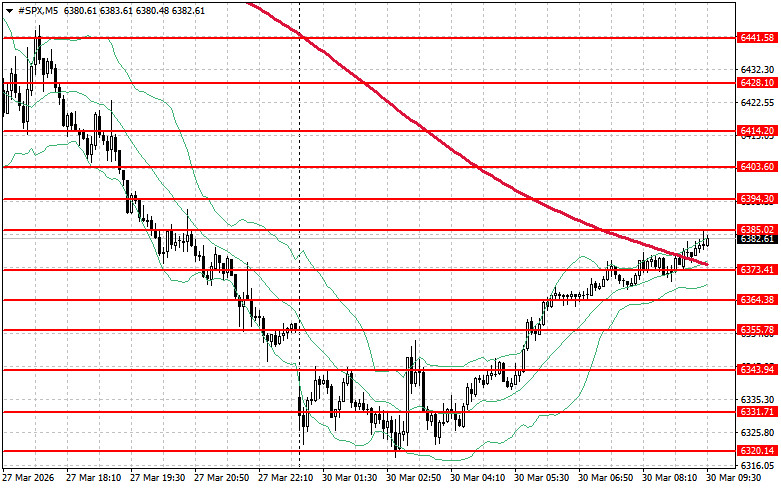
As for the S&P 500 technical picture, the main task for buyers today will be to overcome the nearest resistance level of $6,385. That would help the index gain upside momentum and could pave the way for a thrust to $6,394. Equally a priority for bulls will be control above $6,403, which would strengthen buyers' positions. In the event of a downside move amid reduced risk appetite, buyers must assert themselves around $6,373. A break below that level would quickly push the instrument back to $6,364 and open the path to $6,355.
RÁPIDOS ENLACES



















 Contáctenos