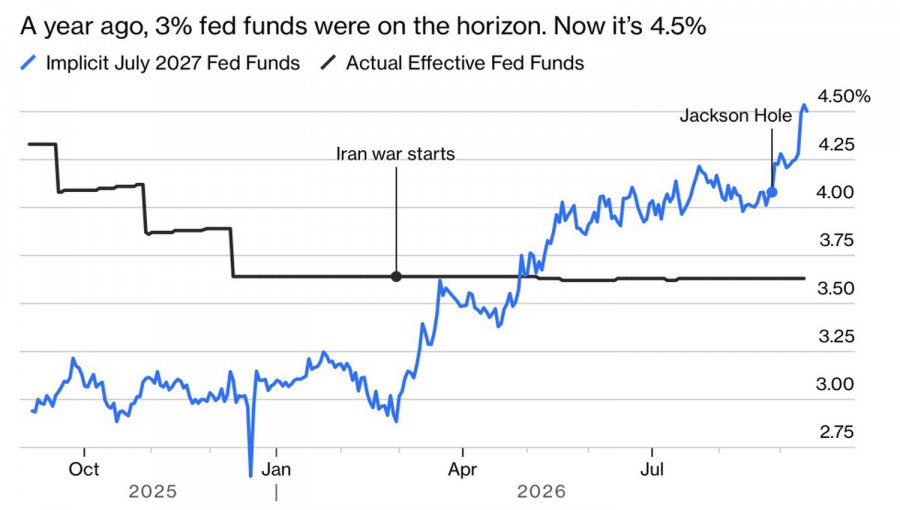
Deja vu of 2007: back then, Treasury yields also surged ahead of a storm that few foresaw. Today, the 10-year Treasury is back near that level. While the parallel is unsettling, the reason for the sell-off is far more prosaic than mortgage derivatives: energy, debt, and inflation. EUR/USD has plunged to a one-month low on this backdrop.
On Tuesday, the global benchmark yield added five basis points to 5.04% — above the 2023 peak and near the 2007 high. The latest push came from rising oil prices amid growing supply risks in the Middle East.
Fed policy and market expectations
The bond sell-off is lifting rates ahead of the Fed decision on Wednesday: investors are now pricing the start of a tightening cycle for the first time since July 2023. If the Fed does not hike, or if Chair Kevin Warsh signals a less aggressive path than the futures market expects, Treasury holders may demand even higher yields as compensation for inflation risk.
It will be very difficult for the Fed to leave interest rates unchanged this week without undermining confidence in its fight against inflation. The market is vulnerable not only to an unexpected pause but also to a "dovish hike" — a subtly soft tone at the press conference. The logic is simple: a single 25-bp move barely moves the economy, and given long monetary lags, the Fed usually keeps tightening until a noticeable cumulative amount — 75 bps or more — has been reached.
Dollar correlation with Treasury yields
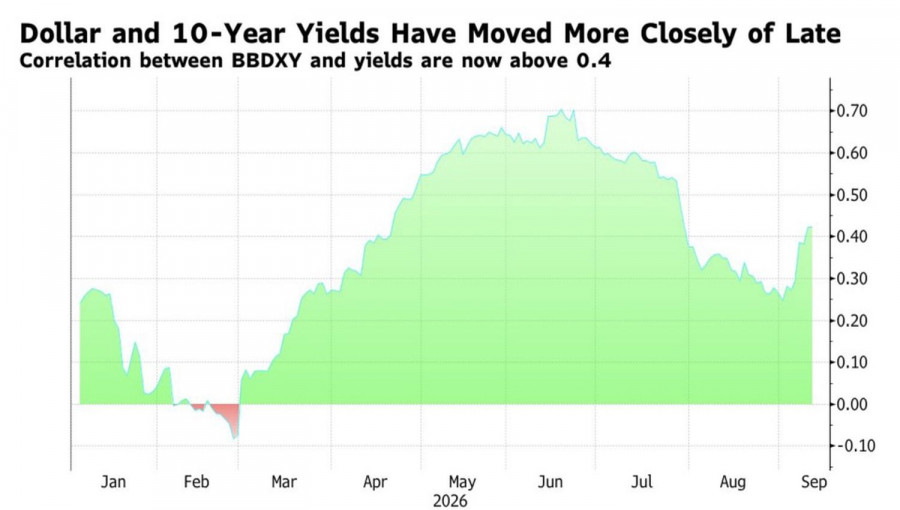
Meanwhile, the 30-day correlation between the US dollar and 10-year yields has risen in September and closed above 0.40 — the highest in over two months. Wells Fargo points to AI-related spending as a partial driver behind the greenback's strength and the rally in bond yields. Foreign investors are converting currency into dollars to buy equities, while tech giants are issuing debt to finance capital expenditures in AI — both factors pushing bond yields higher.
At the same time, traders are increasingly at odds with central banks over future interest rates. Derivatives price in roughly four more ECB hikes and five for the Bank of England over the next 12 months as inflation fears linked to energy resurface.
Oil sharpens the picture
Oil adds urgency. Brent rose for a second day, trading above $107 and intraday approaching $110 — a high not seen since May. Saudi Arabia's East-West pipeline, a bypass route for flows that would otherwise transit the Strait of Hormuz, remains shut after recent attacks, and Aramco has not given a restart timetable. Riyadh is compensating by boosting marine shipments.
Technical view on EUR/USD
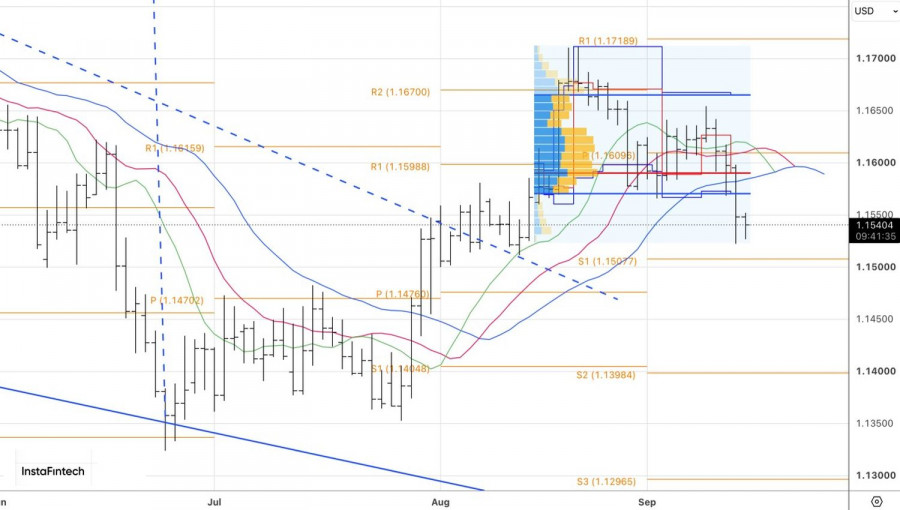
Technically, EUR/USD is completing a 1-2-3 breakdown on the daily chart. Selling toward the pivot levels at $1.15 and $1.147 remains relevant. It makes sense to hold short positions initiated from $1.164.





















 コンタクトする