Index S&P 500 zaznamenal týdenní zisk, přestože v pátek uzavřel beze změny poté, co Financial Times informoval, že prezident Donald Trump zvažuje uvalení cla ve výši nejméně 15 % až 20 % na zboží dovážené z Evropské unie.
Ve 22:00 SEČ index Dow Jones Industrial Average klesl o 142 bodů, tj. o 0,3 %, zatímco index S&P 500 klesl o 0,01 % a index NASDAQ Composite si připsal 0,1 %.
15–20% clo, které prezident zvažuje uvalit na dovoz z EU i v případě dosažení dohody, by bylo vyšší než 10% sazba, kterou EU doufá získat, což naznačuje, že jednání možná uvízla na mrtvém bodě.
S blížícím se termínem zavedení cel 1. srpna se zdá, že Trump zvyšuje tlak na EU, aby ji donutil k větším ústupkům.

Investoři v pátek zpracovávají další čtvrtletní výsledky, které byly dosud obecně přijaty jako pozitivní začátek nové sezóny zveřejňování čtvrtletních výsledků.
Akcie American Express (NYSE:AXP) vzrostly poté, co tento gigant v oblasti kreditních karet překonal odhady zisku za druhé čtvrtletí, a to díky stabilním výdajům svých movitých držitelů karet.
Akcie společnosti 3M Company (NYSE:MMM) posílily poté, co tento průmyslový gigant zvýšil prognózu celoročního zisku, protože se vyplácejí opatření na snížení nákladů a snaha soustředit se na produkty s vysokou marží.
Akcie společnosti Charles Schwab (NYSE:SCHW) vzrostly poté, co finanční gigant oznámil silné výsledky za druhé čtvrtletí, které byly poháněny silným růstem klientských aktiv a zlepšením úrokových marží.
V centru pozornosti bude také Netflix (NASDAQ:NFLX), poté co streamovací gigant oznámil solidní čtvrtletní výsledky a po čtvrtečním uzavření burzy zvýšil svůj roční výhled tržeb.
Akcie Netflixu však po zveřejnění výsledků, které nesplnily zvýšené očekávání analytiků, oslabily.
Cena akcií Netflixu letos dosud vzrostla o více než 43 %, podpořena nadějemi, že společnost bude i nadále posilovat svou pozici jednoho z nejvýznamnějších hráčů v odvětví streamování.
Příští týden se také chystá řada významných výsledků, včetně zpráv od společností Coca-Cola (NYSE:KO), Texas Instruments (NASDAQ:TXN), Alphabet (NASDAQ:GOOGL) (NASDAQ:GOOG) a Tesla (NASDAQ:TSLA).

Index spotřebitelského sentimentu Michiganské univerzity vzrostl na 61,8 bodu a překonal odhady na úrovni 61,5 bodu díky ochlazení inflačních očekávání. Očekávaná roční inflace se zpomalila z 5,0 % na 4,4 %.
Ve čtvrtek byly údaje o maloobchodním prodeji lepší než se očekávalo a týdenní počet žádostí o podporu v nezaměstnanosti byl nižší než prognózy. Inflace také zůstala v červnu téměř v souladu s očekáváními, i když se zdá, že cla tlačí ceny některých zboží nahoru.
V této situaci Federální rezervní systém zaujal k budoucím rozhodnutím o úrokových sazbách převážně vyčkávací postoj.
Guvernér Fedu Christopher Waller však ve čtvrtek uvedl, že snížení sazeb již na příštím zasedání centrální banky v tomto měsíci je oprávněné, a to s ohledem na rostoucí rizika pro ekonomiku.
Dodal, že růst inflace vyvolaný cly pravděpodobně nebude trvalým jevem, ale spíše dočasným výkyvem.
Tyto komentáře přicházejí v době, kdy předseda Fedu Jerome Powell čelí rostoucímu tlaku ze strany prezidenta Trumpa, aby rychle snížil úrokové sazby a podpořil tak ekonomiku.
Pražská burza zakončila týden mírným růstem. Index PX dnes posílil o 0,1 procenta na 2188,67 bodu. Stále se tak drží poblíž svých historických maxim. Do kladných čísel mu pomohly především akcie energetické společnosti ČEZ a také bankovní sektor. Vyplývá to z údajů burzovního webu.
Celkový objem obchodů v Praze dnes činil zhruba 400 milionů korun. Z toho přibližně polovina připadla na cenné papíry ČEZ, které zároveň zhodnotily o 0,49 procenta na 1232 korun. Erste Bank si polepšila o 0,32 procenta na 1863,50 koruny, Komerční banka o 0,2 procenta na 1026 korun a Moneta Money Bank o 0,14 procenta na 145 korun.
Výraznou ztrátu naopak zaznamenaly akcie nápojářské Kofoly, které zlevnily o 3,77 procenta na 510 korun. Zbrojovka Colt CZ oslabila o 1,33 procenta na 744 korun a plzeňské strojírny Doosan Škoda Power o 1,2 procenta na 330 korun. V červeném skončila například i tabáková společnost Philip Morris ČR.
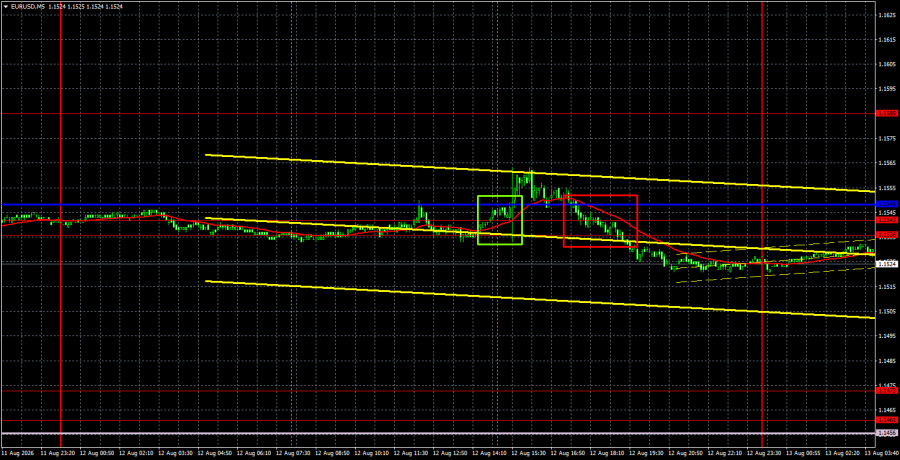
The EUR/USD currency pair on Wednesday, August 12, again traded with low volatility despite a comparatively strong and important macroeconomic backdrop. In fact, there was only one important event yesterday — the US inflation report for July. The actual value of that report disappointed more than it pleased. Not because inflation slowed in July, but because the figure matched forecasts. Since the market correctly guessed the forecasts, there was essentially nothing to react to. Inflation in the US slowed to 3.4%, but it did not provide a clear answer on whether to expect Federal Reserve monetary tightening in September. In our view, attempting to answer that question now makes little sense. Before the next Fed meeting, another inflation report and another labor market report will be released. Obviously, the Fed will base its September decision on those data. Yesterday's report showed a second consecutive slowdown, but a very weak slowdown — only 0.1% year-on-year. Thus, US inflation remains elevated and requires Fed intervention. And in August, this indicator could accelerate again, since oil prices have risen this month and the Strait of Hormuz remains blocked.
In technical terms, the pair left the sideways channel 1.1362–1.1461 after a month of "walking through torments" and is now in an uptrend. The euro is generally rising, but we believe this is not enough. The dollar currently has virtually no trump cards. It is saved only by the fact that it is the world's most popular currency and therefore cannot, a priori, collapse every day.
In the 5-minute timeframe on Wednesday, two trading signals were formed, neither of which resulted in a profit for traders. First, the pair consolidated above the 1.1536–1.1548 area, and then below it. In neither the first nor the second case did the price move the necessary 15 pips in the required direction.
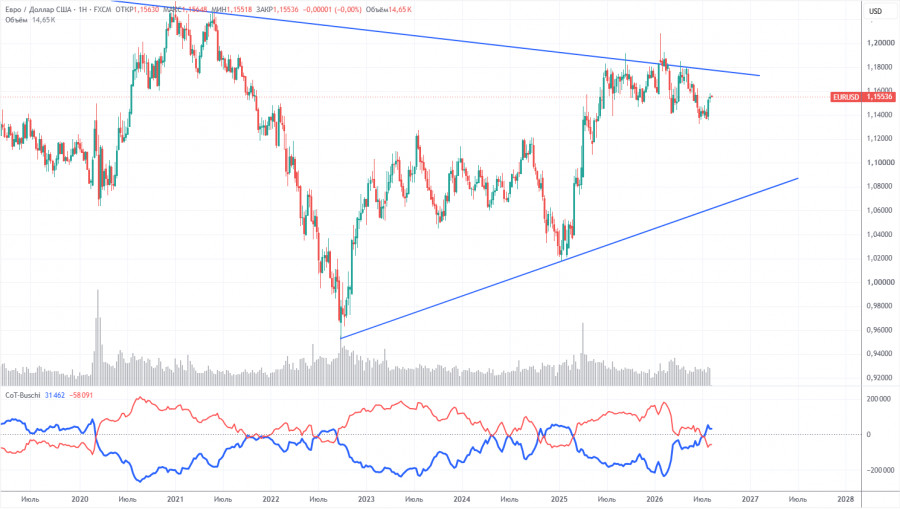
The latest COT report is dated August 4. In the weekly TF illustration, it is clear that the net position of non-commercial traders has turned "bearish" and has significantly decreased in 2026 due to geopolitical events. Traders have been shedding the euro in recent months in favor of the US dollar. Donald Trump's policy has not changed, but the dollar has, for a time, acted as a "reserve currency."
We still do not see any fundamental factors to strengthen the euro, while there remain sufficient factors for the US currency to decline. The war in the Middle East temporarily made the dollar super-attractive, but when that factor's "shelf life" expires, everything will return to normal. In the long term, the euro could fall as low as $1.08 (along the trend line), but the uptrend will remain relevant. And after recent months of dollar strength, the pair has not moved too close to that line.
The placement of the red and blue indicator lines points to parity between bulls and bears. During the last reporting week, the number of longs in the "Non-commercial" group decreased by 3,100, while the number of shorts decreased by 17,500. Accordingly, the net position for the week increased by 14,400 contracts.
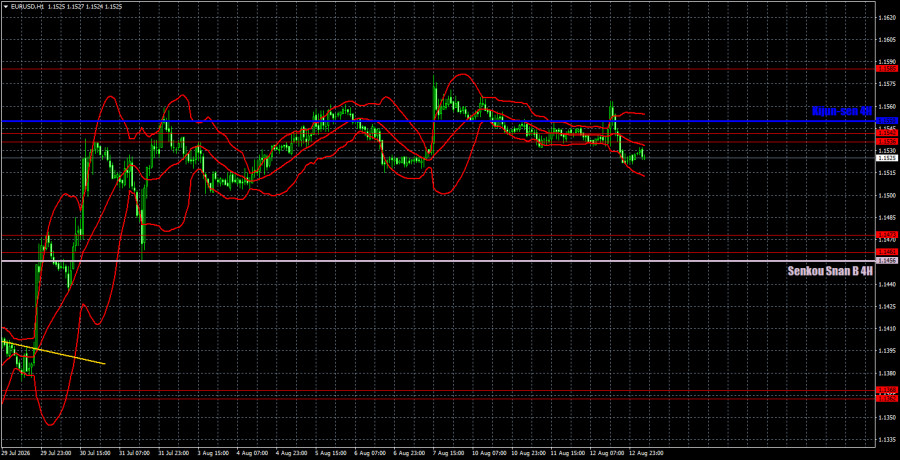
On the hourly timeframe, the pair continues its upward tendency but may correct in the coming days. The situation in the Middle East remains tense and is not improving, but this is already insufficient to trigger a new, powerful dollar rally. In recent months, the market ignored all euro-positive background and focused solely on Fed monetary policy, imposing excessive expectations on it. Now the veil is lifting from traders' eyes, so the euro has every chance for medium-term growth.
For August 13 we highlight the following levels for trading — 1.1234, 1.1274, 1.1362–1.1368, 1.1461–1.1473, 1.1536–1.1542, 1.1585, 1.1657–1.1666, 1.1750–1.1760, 1.1786, 1.1830–1.1837, as well as Senkou Span B (1.1456) and Kijun-sen (1.1550) lines. The Ichimoku indicator lines may shift during the day, which should be taken into account when determining trading signals. Do not forget to move the stop-loss to break-even if the price moves 15 pips in the correct direction. This will protect against potential losses if the signal proves false.
On Thursday, the EU will publish an industrial production report, and the US will release the producer price index. We consider both reports secondary and do not expect a market reaction to them.
Today, traders may remain in short positions with a target of 1.1461–1.1473, since the pair consolidated below the 1.1536–1.1542 area. Consolidation above the 1.1536–1.1548 area will allow opening long positions with targets of 1.1585 and 1.1657–1.1666.
Price support and resistance levels (resistance/support) – thick red lines near which movement may end. They are not sources of trading signals.
Kijun-sen and Senkou Span B lines – Ichimoku indicator lines transferred to the hourly timeframe from the 4-hour. They are strong lines.
Extreme levels – thin red lines from which price previously bounced. They are sources of trading signals.
Yellow lines – trend lines, trend channels, and any other technical patterns.
Indicator 1 on the COT charts – the size of the net position of each trader category.

RYCHLÉ ODKAZY




















 Kontaktujte nás